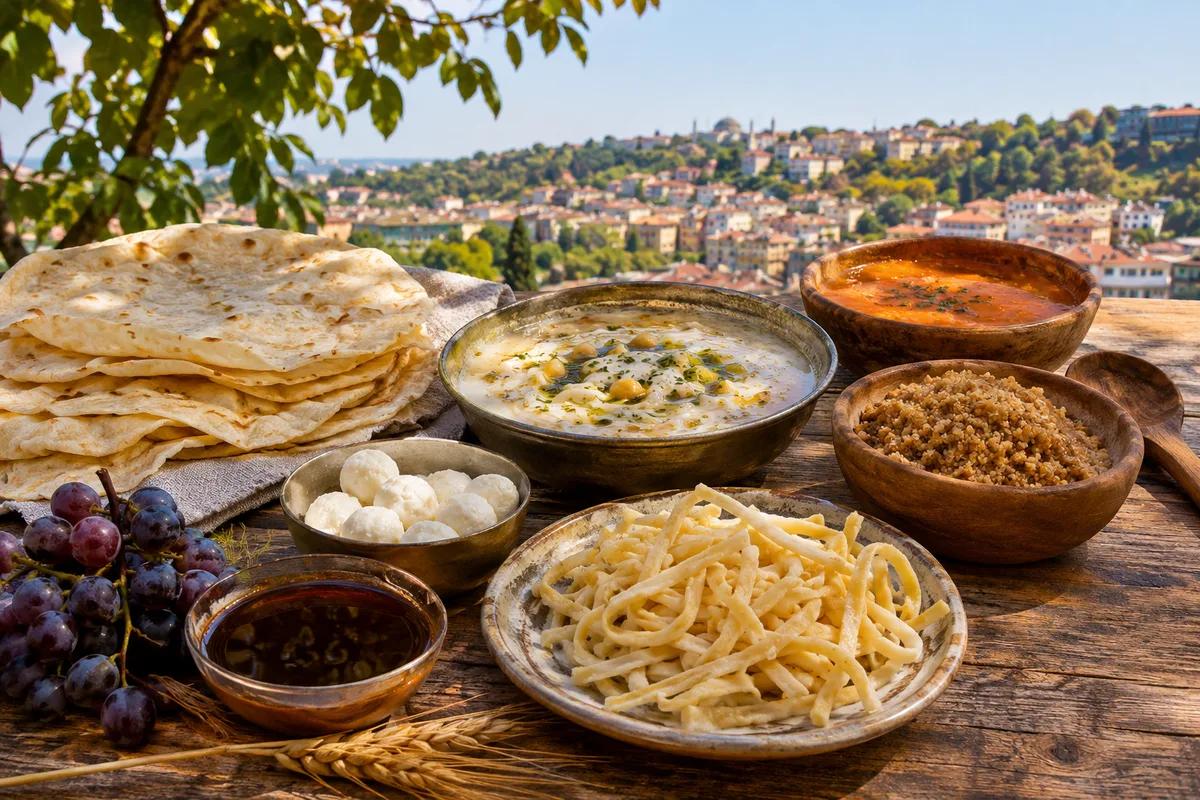
From Central Asia to Istanbul: The Vegan and Vegetarian Foods That Traveled With the Turks
Long before modern vegan diets, Turkic communities were making flatbreads, noodles, roasted-grain dishes and preserved foods. Some of those traditions survived the journey to Anatolia and can still be found in Istanbul today
When Turkic communities began settling in Anatolia in large numbers during the 11th century, they brought more than their herds, languages and customs. They also carried a food culture shaped by the grasslands, mountains and farming settlements of Central Asia.
Meat and dairy were important parts of that culture, but they were far from the whole story. Wheat, barley, millet, flatbreads, noodles and preserved foods also belonged to the everyday diet.
For vegans and vegetarians visiting Istanbul, this history offers a different way to explore Turkish cuisine. Some of the simplest foods served in the city today have connections to culinary traditions that existed centuries before the Ottoman Empire.
But there is an important distinction: Not every traditional Turkish dish originated in Central Asia. Some recipes traveled west with Turkic communities, others evolved after they encountered Anatolian, Persian, Byzantine and other regional food traditions.
🌾 1. Yufka: The flatbread that crossed centuries
Yufka is one of the clearest connections between early Turkic food traditions and the modern Turkish table.
Made by rolling dough into thin sheets, yufka has long been associated with cooking on a sac, a slightly convex metal griddle placed over a fire.
The 11th-century Turkic dictionary Dīwān Lughāt al-Turk, compiled by Mahmud al-Kashgari, documents early Turkic bread and dough traditions, including yufka.
Today, yufka remains part of Anatolian home cooking and is used in various breads, wraps and pastries.
Where to find it in Istanbul: Look for traditional yufkacı shops, neighbourhood markets and restaurants preparing fresh gözleme or sac bread.
🌱 Vegan check: Plain yufka made with flour, water and salt is vegan. Some commercial versions or filled pastries contain milk, butter, cheese or eggs. Ask about the dough and any added fat.
🍜 2. Tutmaç: A medieval noodle soup that survived
Long before pasta became a familiar part of international cuisine, Turkic communities were preparing dishes made with cut or shaped dough.
One of them was tutmaç, a dish recorded in Kashgari's 11th-century dictionary.
Modern Anatolian versions typically combine small pieces of dough with lentils or chickpeas. Some include yogurt, while others use meat stock or meat.
The ingredients and preparation have changed over time, so today's tutmaç should not be mistaken for an exact reconstruction of the medieval recipe.
Where to find it in Istanbul: Regional Anatolian restaurants and traditional soup establishments are more likely to serve tutmaç than ordinary tourist restaurants.
🥛 Vegetarian check: Yogurt-based tutmaç may be vegetarian if it contains no meat or meat stock. A vegan version requires vegetable stock and no dairy or eggs.
🍞 3. Kavut: The ancient art of roasting grain
Kavut is among the more distinctive foods associated with the older Turkic culinary world.
Its preparation begins with roasting grain, which is then ground and eaten in different ways. Historical Turkic sources document related grain preparations.
In parts of eastern Anatolia, kavut survives as a regional specialty. Depending on the recipe, it may be prepared with flour, grain, molasses, butter or other ingredients.
It is an example of a food tradition built around preservation and the practical use of grains rather than elaborate cooking.
Where to find it in Istanbul: Kavut is uncommon on standard restaurant menus. Regional food shops and businesses specialising in eastern Anatolian products are more promising places to look.
🌱 Vegan check: Grain-based kavut can be vegan, but many contemporary recipes contain butter or other dairy products. Honey is another ingredient to check.
🍝 4. Erişte and ügre: The roots of Turkish noodle-making
Noodles are another important part of the historical connection between Central Asia and Anatolia.
Early Turkic sources refer to ügre, a preparation associated with cut dough and soup. The wider tradition of preparing dough in strips or pieces continued in Anatolian cooking.
Today, erişte is a familiar Turkish noodle, often made at home, dried and stored for later use.
Unlike Italian pasta, traditional Turkish erişte frequently contains eggs and sometimes milk.
Where to find it in Istanbul: Look for homemade erişte in regional restaurants, traditional food markets and shops selling Anatolian products. It may appear as a side dish, a main course or an ingredient in soup.
🌱 Vegan check: Erişte made exclusively from flour and water can be vegan. Do not assume that homemade or traditional erişte is egg-free.
🫓 5. Kömeç and közmen: Bread before the modern oven
Before modern bakeries, people prepared bread using hot stones, embers, ashes and simple cooking surfaces.
Early Turkic culinary vocabulary includes terms such as kömeç and közmen, associated with older bread-making methods.
These foods illustrate how cooking techniques traveled across regions, although it would be misleading to identify any particular modern Istanbul bread as their unchanged descendant.
Where to find related traditions in Istanbul: Traditional bakeries, regional Anatolian restaurants and places preparing bread on a sac offer opportunities to encounter similar cooking methods.
🌱 Vegan check: Simple flour-and-water breads may be vegan. Check for butter, milk, yogurt and eggs, particularly in richer regional breads.
🥛 6. Kurut: The Central Asian food-preservation tradition
Kurut tells a different story about the movement of food across Central Asia and Anatolia.
For communities that depended on livestock and traveled long distances, preserving milk was essential. One solution was to strain and dry fermented dairy products into pieces that could be stored and transported.
Known as kurut in Turkic culinary traditions, this preserved food was documented in medieval sources and remains familiar in several Central Asian countries.
In Anatolia, related products include keş and certain forms of dried yogurt or cheese.
Where to find it in Istanbul: Regional shops selling eastern Anatolian products are more likely to carry kurut or keş than ordinary supermarkets.
🥛 Vegetarian check: Kurut is dairy-based and therefore not vegan. Traditional preparations generally qualify as vegetarian when they contain no meat-derived ingredients or animal rennet.
🍇 7. Pekmez: A sweet tradition older than refined sugar
Pekmez, a thick syrup made by concentrating fruit juice, is one of the traditional sweet foods recorded in early Turkic vocabulary.
The 11th-century Dīwān Lughāt al-Turk includes bekmes, a historical form of the word pekmez.
Today, grape and mulberry pekmez are common in Türkiye, while other varieties reflect local agricultural traditions.
The historical connection does not mean every type of pekmez originated in Central Asia. Rather, it demonstrates the long history of fruit preservation and concentrated sweeteners in Turkic food culture.
Where to find it in Istanbul: Traditional breakfast restaurants, neighborhood markets and shops selling regional Anatolian products.
🌱 Vegan check: Plain fruit pekmez is vegan. Products blended with honey, dairy or other ingredients need to be checked separately.
🍲 8. Tarhana: A soup shaped by centuries of cultural exchange
Tarhana is often described as a food brought from Central Asia by migrating Turkic communities. Its history, however, is more complicated.
The traditional preparation combines fermented grain and dairy products, which are dried and later cooked into soup. Similar preserved foods exist across Anatolia, the Balkans, the Middle East and Central Asia.
Researchers have proposed different explanations for tarhana's origins, and no single account fully establishes where the modern dish was first created.
What is clear is that fermentation and drying were important food-preservation techniques in the wider region.
Today's Turkish tarhana often contains tomatoes and peppers, ingredients that became available in the Old World after contact with the Americas. Those versions cannot be identical to medieval Central Asian preparations.
Where to find it in Istanbul: Traditional soup restaurants, neighborhood lokantas and markets selling homemade dried tarhana.
🥛 Vegetarian check: Most traditional tarhana contains yogurt. A fully vegan version must be prepared without dairy, and the finished soup must contain no butter or meat stock.
What about bulgur, keşkek, boza and helva?
These foods are frequently associated with traditional Turkish cuisine, but their histories cannot be reduced to a single migration route.
Bulgur and cracked-wheat preparations have deep roots in Anatolia and the wider Middle East. Keşkek belongs to a shared regional tradition of cooking grain, frequently with meat. Boza has connections to old fermented grain drinks, while the history of helva involves several culinary traditions.
Some modern versions are vegan or vegetarian, but it would be inaccurate to describe all of them as foods that Turks introduced to Anatolia from Central Asia.
🗣️ How to order these foods in Istanbul
A traditional dish is not necessarily vegan, even when its main ingredient is wheat, fruit or vegetables. Butter, yogurt, eggs and meat stock can change its suitability.
USEFUL TURKISH PHRASES
“İçinde tereyağı, süt, yoğurt veya yumurta var mı?”
Does it contain butter, milk, yogurt or eggs?
“Et suyu veya tavuk suyu kullanıyor musunuz?”
Do you use meat or chicken stock?
“Hayvansal ürün içermeyen bir seçeneğiniz var mı?”
Do you have an option without animal products?
A culinary journey that never really ended
Istanbul's food culture is often explained through its Ottoman, Byzantine, Greek, Armenian, Jewish and other regional influences. The food traditions brought westward by Turkic communities add another layer to that history.
The connection is particularly visible in the treatment of grain: rolling dough into thin sheets, making noodles, roasting cereals and preserving food for later use.
Not every dish survived unchanged, and many became part of a shared culinary heritage rather than remaining exclusive to one community.
For visitors exploring Istanbul without eating meat, these traditions offer more than historical curiosity. They provide another way to understand why bread, grains, fermented foods and simple regional preparations remain central to Turkish cooking.
The journey from Central Asia to Anatolia did not preserve a single fixed menu. It helped create a cuisine that continued to absorb new ingredients, techniques and influences for centuries.
Historical references: Mahmud al-Kashgari's 11th-century Dīwān Lughāt al-Turk is a principal source for early Turkic food terminology. Academic studies of the dictionary document tutmaç, ügre, kavut, yufka, közmen, kurut and pekmez. Modern research also examines the disputed origins and regional variations of tarhana.