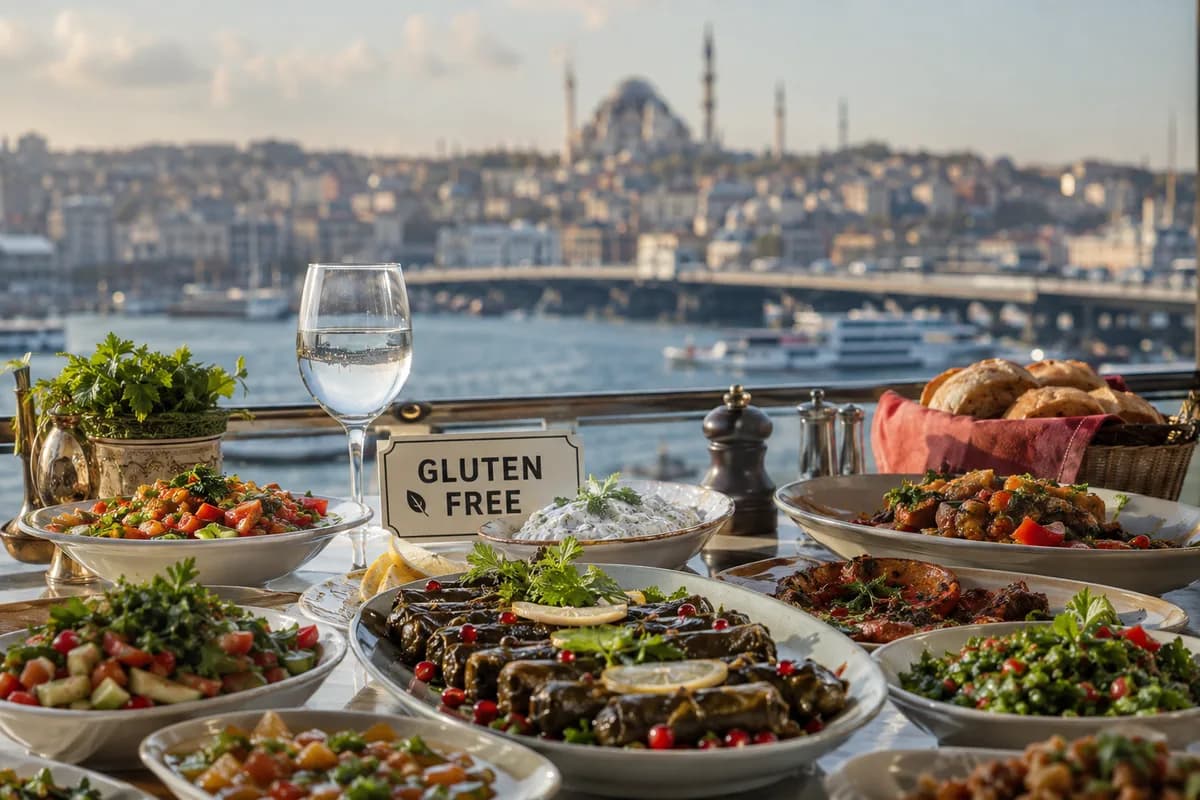
🌾 Gluten-Free Turkish Food in Istanbul: What Can I Eat?
Here are some of the best Turkish foods to look for and the questions to ask before ordering gluten safe food in Istanbul. Compiled by Veganistanbul.com editors
Eating gluten-free in Istanbul is easier than it may first appear. Turkish cuisine has plenty of dishes based on vegetables, legumes, rice, yogurt, meat and olive oil rather than wheat.
But there is an important distinction: a dish that looks naturally gluten-free is not automatically safe for someone with celiac disease. Flour may be used for thickening, meatballs can contain breadcrumbs, fries may share oil with breaded foods, and bread is frequently prepared or served around other dishes.
Here are some of the best Turkish foods to look for and the questions to ask before ordering.
🍆 İmam Bayıldı
What is it? Eggplant slowly cooked with onion, tomato, garlic and plenty of olive oil.
🌾 Usually gluten-free: Yes 🌱 Usually vegan: Yes
⚠️ Check: It is normally one of the safest traditional choices, but ask whether anything containing flour is added during preparation.
Say:
“Bu yemek glutensiz mi?”
“Is this dish gluten-free?”
🫘 Barbunya Pilaki
What is it? Borlotti beans cooked with tomato, onion, carrot and olive oil, usually served cold.
🌾 Usually gluten-free: Yes 🌱 Usually vegan: Yes
⚠️ Check: The traditional recipe doesn't need flour, but restaurant recipes vary.
💡 Look for it among the zeytinyağlılar the olive-oil dishes displayed in many Turkish restaurants.
🫛 Zeytinyağlı Vegetables
Green beans (taze fasulye), artichokes (enginar), leeks (pırasa) and similar vegetables cooked using olive oil can be excellent choices.
🌾 Usually gluten-free: Yes 🌱 Usually vegan: Yes
⚠️ Check: Ask whether flour was used to thicken the sauce.
🍃 Stuffed Vine Leaves / Yaprak Sarma
Vine leaves filled with seasoned rice, herbs and sometimes pine nuts or currants.
🌾 Potentially gluten-free 🌱 Usually vegan when sold as zeytinyağlı yaprak sarma
⚠️ Check: Make sure the filling contains rice rather than bulgur. Bulgur is wheat and is not gluten-free.
Say:
“İçinde bulgur var mı? Sadece pirinç mi?”
“Does it contain bulgur? Is it only rice?”
🫑 Zeytinyağlı Dolma
Peppers, aubergines, courgettes or other vegetables stuffed with a seasoned rice mixture.
🌾 Potentially gluten-free 🌱 Often vegan
⚠️ The same rule applies: rice is fine; bulgur is not. Always ask which grain was used.
🥗 Çoban Salatası
One of Turkey's simplest salads: tomato, cucumber, peppers, onion and parsley, usually dressed with lemon and olive oil.
🌾 Naturally gluten-free 🌱 Vegan
⚠️ For celiac travelers, ask for it without bread or croutons and be aware that preparation surfaces may be shared.
🍆 Şakşuka
Fried aubergine and other vegetables topped with tomato sauce.
🌾 Usually gluten-free 🌱 Usually vegan
⚠️ The fryer is the problem. Ask whether the vegetables are fried in oil also used for breaded foods.
Say:
“Aynı yağda unlu veya pane ürün kızartılıyor mu?”
“Are breaded or flour-coated foods fried in the same oil?”
🥛 Cacık
Yogurt mixed with cucumber, garlic, herbs and sometimes olive oil.
🌾 Usually gluten-free 🥛 Vegetarian, not vegan
It is generally a straightforward gluten-free side dish, but celiac travelers should still mention their dietary requirement when ordering.
🧆 Hummus
Chickpeas, tahini, lemon and garlic make the basic recipe naturally gluten-free.
🌾 Usually gluten-free 🌱 Usually vegan
⚠️ Cross-contact matters: hummus is frequently served alongside bread. Ask for no bread on the plate.
🍚 Rice Pilav / Pirinç Pilavı
This one is deceptive.
Rice itself is gluten-free, but Turkish rice pilaf frequently contains şehriye, which is small pieces of wheat-based vermicelli or orzo.
⚠️ Never assume Turkish pilav is gluten-free.
Say:
“Pilavda şehriye var mı?”
“Does the rice contain vermicelli/orzo?”
Look for plain rice: sade pirinç pilavı.
🍖 Izgara Et & Tavuk / Grilled Meat & Chicken
Plain grilled lamb, chicken, steak or chops can be among the easiest main courses to order.
🌾 Potentially gluten-free
⚠️ Ask about marinades, sauces, seasoning mixes and the grill itself. Bread may be toasted on the same grill.
Say:
“Marine sosunda veya baharat karışımında gluten var mı?”
“Is there gluten in the marinade or seasoning?”
🧆 Köfte: Be Careful!
Turkish meatballs may look like plain meat, but many recipes contain breadcrumbs or stale bread.
🚫 Do not assume köfte is gluten-free.
Ask specifically:
“Köftenin içinde ekmek, galeta unu veya normal un var mı?”
“Does the köfte contain bread, breadcrumbs or regular flour?”
🍲 Mercimek Çorbası: Ask First
Lentil soup is everywhere in Istanbul but it is not reliably gluten-free.
Some restaurants thicken it with wheat flour, and recipes vary considerably.
⚠️ Ask:
“Mercimek çorbasında un var mı?”
“Does the lentil soup contain flour?”
For celiac travelers, also ask about stock and preparation.
🍳 Menemen
Eggs cooked with tomatoes and peppers, sometimes with onion.
🌾 Normally gluten-free 🥚 Vegetarian
⚠️ Bread is almost always served alongside it. Tell the restaurant that simply removing the bread isn't sufficient if you need to avoid cross-contact.
🥔 Patates Kızartması / French Fries
Potatoes contain no gluten. The fryer may.
🌾 Only safe if the cooking process is safe
⚠️ A shared fryer used for breaded chicken, croquettes or other flour-coated foods can cause cross-contact.
For people with celiac disease, “the ingredients are gluten-free” is not enough.
🍮 Sütlaç / Turkish Rice Pudding
The traditional dessert is based on milk, rice and sugar.
🌾 Often gluten-free 🥛 Vegetarian
⚠️ Restaurant and commercial recipes can differ, so confirm whether wheat flour, starch mixtures or gluten-containing ingredients have been added.
🚨 Foods That Are NOT Gluten-Free
Some Turkish foods can easily cause confusion. Avoid regular versions of:
Simit • pide • lahmacun • börek • gözleme • mantı • bulgur pilavı • kısır • çiğ köfte made with bulgur • regular baklava • regular bread and pastries
And remember: bulgur is wheat.
🗣️ The Most Useful Turkish Sentence
If you have celiac disease, don't simply say “Glutensiz istiyorum” (“I want gluten-free”).
Say:
“Çölyak hastasıyım. Gluten ve unlu yiyemiyorum. Çok az miktarda gluten veya un bile sağlığım için büyük sorun olur.”
“I have celiac disease. I cannot eat gluten or flour. Even a very small amount of gluten or food made with flour is a big problem.”
And when cross-contact matters:
“Yemeğin ayrı hazırlanması gerekiyor. Ekmek, un ve glutenli ürünlerle temas etmemeli.”
“The food needs to be prepared separately. It must not come into contact with bread, flour or foods containing gluten.”
⚠️ Gluten-Free Survival Tips for Istanbul
Don't trust appearances. Soup, köfte (meatball), rice and sauces are four particularly easy places for hidden wheat to appear.
“Glutensiz” doesn't necessarily mean celiac-safe. A restaurant may offer gluten-free bread or pasta while preparing it in a kitchen full of wheat flour.
Ask about the fryer and grill. Shared cooking equipment matters when avoiding cross-contact.
Watch the bread basket. Turkish restaurants commonly place bread directly on or beside food. Ask for no bread before the plate reaches the table.
Choose dedicated gluten-free businesses when possible. For travellers with celiac disease, a gluten-free kitchen can remove much of the uncertainty involved in ordering from a conventional restaurant.
🏆 Gluten-Free Places to Know in Istanbul
For visitors who want more than naturally gluten-free Turkish dishes, Istanbul now has several businesses specialising in gluten-free food.
🌾 Rolla GlutenFree / Koşuyolu, Kadıköy
One of Istanbul's most established dedicated gluten-free addresses. Rolla describes its production kitchen as gluten-free only and says its products undergo periodic analysis at accredited laboratories. Its menu ranges from burgers and wraps to bakery products, desserts and even a gluten-free version of Istanbul's ıslak hamburger.
(https://www.veganistanbul.com/en/venue/rolla-glutenfree)
🍕 d’Amalfi Senza Glutine / Moda, Kadıköy
A gluten-free Italian-focused restaurant in Kadıköy, particularly useful when you want pizza and other foods that are normally difficult to find in gluten-free form. Current Istanbul gluten-free guides identify it as a specialist gluten-free destination.
(https://www.veganistanbul.com/en/venue/d-amalfi-senza-glutine)
🍰 Guru Glutensiz Moda / Moda, Kadıköy
A gluten-free restaurant and patisserie with both savoury dishes and desserts. Guru also publishes a current 2026 product catalogue and an English menu, which makes it particularly practical for international visitors.
(https://www.veganistanbul.com/en/venue/guru-glutensiz-moda)
🥐 Tatlı Fırın Cadde / Fenerbahçe, Kadıköy
A useful address for gluten-free bakery and pastry products. The Turkish Celiac Patients Association lists Tatlı Fırın and states that all its products are gluten-free.
(https://www.veganistanbul.com/en/venue/tatli-firin-cadde)
🛍️ Glutensiz.com Market ve Cafe Etiler / Etiler, Beşiktaş
Part café, part specialist shop, making it useful for travellers who need packaged gluten-free products as well as something to eat during their stay.
(https://www.veganistanbul.com/en/venue/glutensiz-com-cafe-etiler)
🏛️ Cafe Amedros / Sultanahmet
Unlike the dedicated gluten-free businesses above, this is a conventional restaurant. Its big advantage for tourists is location: it is in the historic peninsula. Current celiac-oriented restaurant guides report a separate gluten-free menu and numerous gluten-free choices. Cross-contact should nevertheless be discussed with staff if you have celiac disease.
(https://www.veganistanbul.com/en/venue/amedros-cafe-restaurant)
📌 One Rule to Remember
Naturally gluten-free ≠ automatically celiac-safe.
Istanbul has plenty to eat without gluten. The challenge is often not the basic Turkish recipe but flour added by a particular kitchen, bulgur instead of rice, breadcrumbs in meatballs, shared frying oil, bread on the plate and cross-contact during preparation.
Ask first, explain clearly, and when the medical risk is significant, favour restaurants and bakeries with dedicated gluten-free preparation.
📌 Save this for your Istanbul trip. Tag another celiac traveler who needs it.
Last reviewed: September 01, 2026