🇹🇷 How to Make Turkish Vegan Kuru Fasulye: A Step-by-Step Recipe
Here is a practical, step-by-step recipe for vegan kuru fasulye, for who wants to recreate one of Turkey’s most familiar home-cooked dishes in their own kitchens. The instructions explain what to buy, how to prepare the beans, what each stage should look like and how to achieve the characteristic Turkish flavour
Discover one of Turkey’s most popular comfort foods and learn how to cook it yourself.
Walk into a traditional Turkish esnaf lokantası, a casual restaurant serving home-style meals, and you will probably find kuru fasulye on the menu.
This hearty white bean stew is a staple of Turkish home cooking. It is inexpensive, filling and easy to prepare with ingredients available in most supermarkets.
Although some Turkish restaurants prepare kuru fasulye with meat, sausage or butter, the traditional tomato-and-onion base works equally well without animal products.
Here is how to make a completely vegan version in your own kitchen, even if you have never cooked Turkish food before.
🫘 What You Need
Preparation: 15 minutes, plus overnight soaking
Cooking: Approximately 60–90 minutes with dried beans
Servings: 4
Difficulty: Easy
Ingredients
- 2 cups (about 400 g) dried white beans
- 1 large onion, finely chopped
- 2 medium tomatoes, grated or finely chopped
- 1 tablespoon tomato paste (domates salçası)
- 1 tablespoon sweet red pepper paste (tatlı biber salçası), optional
- 3 tablespoons olive oil
- 1 green pepper, chopped
- 2 cloves garlic, minced (optional)
- 1 teaspoon sweet paprika
- ½ teaspoon black pepper
- Salt to taste
- 3–4 cups hot water, plus more if necessary
🛒 Shopping in Istanbul: Look for dried white beans labeled kuru fasulye in supermarkets or neighborhood grocery stores.
Small white beans are particularly suitable, but cannellini or other medium-sized white beans work too.
For a faster version, you can substitute approximately three 400 g cans of cooked white beans, drained and rinsed.
👩🍳 Step 1: Prepare the Beans
If using dried beans, begin the evening before cooking.
- Place the beans in a large bowl.
- Cover them generously with cold water.
- Leave them to soak for 8–12 hours.
- Drain and rinse thoroughly.
What should you see?
The beans should have absorbed water, expanded and become slightly softer. They will still be firm because they are not yet cooked.
Important: Soaking reduces cooking time but does not replace cooking.
If your kitchen is warm, soak the beans in the refrigerator.
🍲 Step 2: Cook the Beans Until Almost Tender
Transfer the soaked beans to a large saucepan and cover with fresh water.
Bring to a boil, then reduce the heat and simmer gently for approximately 35–60 minutes, depending on the variety and age of the beans.
Test one by pressing it between your fingers or tasting it carefully.
What should you look for?
The bean should be nearly tender, with only slight resistance in the center. It should no longer taste raw or chalky.
Drain and set aside.
Do not worry if the beans are not completely soft. They will finish cooking in the tomato sauce.
Using canned beans? Skip Steps 1 and 2. Your beans are already cooked.
🧅 Step 3: Build the Turkish Flavor Base
This is where kuru fasulye gets much of its distinctive flavor.
- Heat the olive oil in a large, heavy-bottomed pot over medium heat.
- Add the chopped onion.
- Cook for 5–7 minutes, stirring occasionally.
- Add the green pepper and cook for another 3 minutes.
- Stir in the garlic, if using.
What should you see?
The onions should become soft and translucent, with a little golden color around the edges. They should not turn dark brown.
The peppers should soften and release their aroma.
A common mistake: Cooking the onions too quickly over high heat. Give them time to soften because they form the foundation of the sauce.
🍅 Step 4: Make the Tomato Sauce
Add the tomato paste and optional red pepper paste to the softened vegetables.
Stir continuously for about 1 minute.
Then add the grated tomatoes, paprika and black pepper.
Cook for another 5–7 minutes.
What should you see?
The mixture should gradually become thicker, darker red and more concentrated.
The raw smell of tomato paste should disappear.
You should now have a rich tomato mixture rather than a watery sauce.
Why this matters: Turkish kuru fasulye relies heavily on the flavor developed by cooking the tomato paste in oil before adding liquid.
The red pepper paste is optional, but it adds depth and a slightly sweet pepper flavor.
🫘 Step 5: Bring Everything Together
Add the partially cooked beans to the tomato mixture.
Stir gently until they are coated in the sauce.
Pour in approximately 3 cups of hot water.
The liquid should cover the beans by about 1–2 cm.
Bring everything to a gentle simmer.
What should you see?
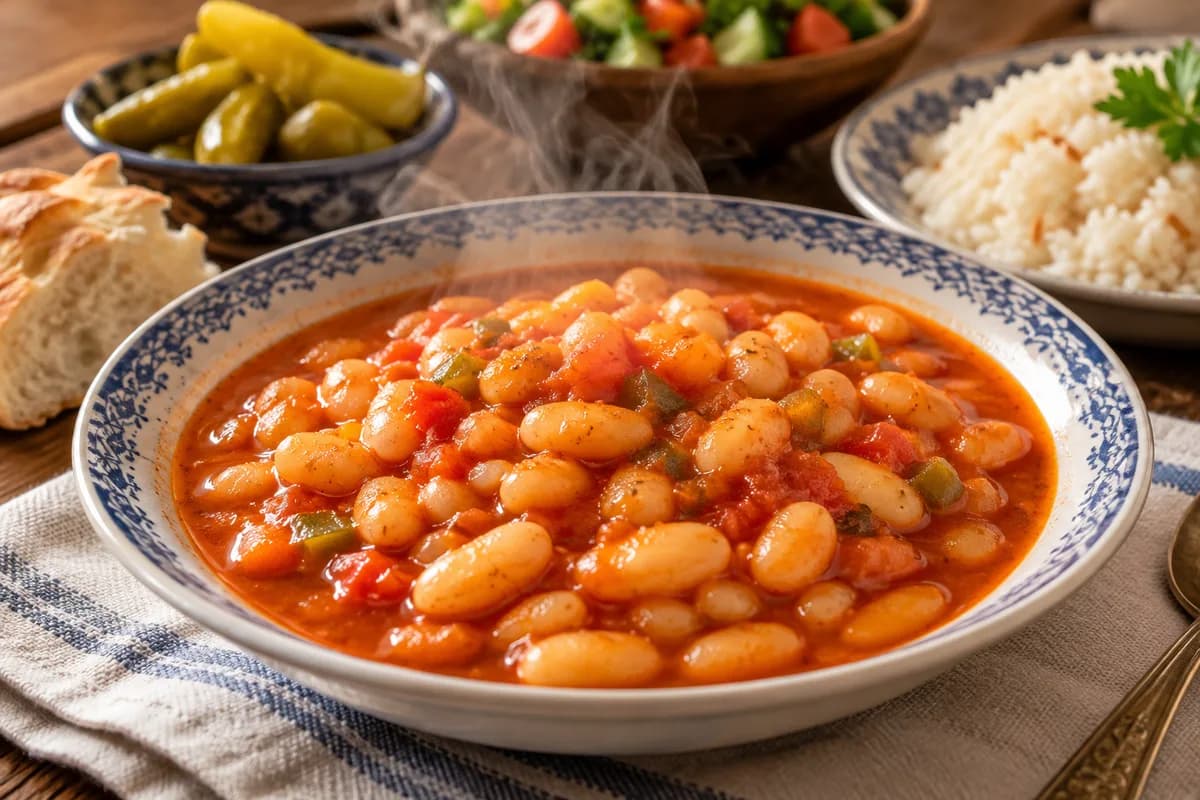
The beans should sit in a reddish sauce that is thin enough to bubble gently but not so watery that it resembles soup.
If necessary, add a little more hot water.
⏲️ Step 6: Let the Stew Develop Its Flavor
Cover the pot partially and cook over low heat for approximately 20–35 minutes, stirring occasionally.
The exact time depends on how tender the beans were before adding them to the sauce.
Add salt toward the end and adjust the seasoning.
How do you know it is ready?
Check three things:
✅ The beans: They should be completely tender and creamy inside, without a hard center.
✅ The sauce: It should be slightly thick, coating the beans rather than running off them like water.
✅ The flavor: The tomatoes, onions and beans should taste integrated rather than like separate ingredients.
If the sauce is too thin, remove the lid and simmer for another 5–10 minutes.
If it becomes too thick, add a little hot water.
A useful Turkish cooking trick: Mash two or three cooked beans against the side of the pot and stir them back into the sauce. Their starch will naturally thicken the stew without flour.
🍽️ Step 7: Let It Rest and Serve
Turn off the heat and let the kuru fasulye rest for 10–15 minutes.
This allows the sauce to settle and thicken slightly.
Serve warm in a shallow bowl or deep plate, with some sauce surrounding the beans.
What Do Turkish People Eat With Kuru Fasulye?
🍚 Rice pilaf (pirinç pilavı): The classic accompaniment. For a vegan meal, prepare it with olive oil instead of butter and use water or vegetable stock rather than chicken stock.
🌾 Bulgur pilaf (bulgur pilavı): Another traditional option, made from cracked wheat. It contains gluten.
🥒 Pickles (turşu): Pickled cucumbers, peppers or cabbage provide a sharp contrast to the rich beans.
🧅 Raw onion: Thinly sliced onion, sometimes sprinkled with sumac, is a common accompaniment.
🥗 Çoban salatası: A simple Turkish salad of tomatoes, cucumbers, onions, parsley, lemon juice and olive oil.
A bowl of kuru fasulye with rice pilaf and pickles is one of the most recognizable combinations in everyday Turkish cuisine.
⚡ Short on Time? Try the 30-Minute Version
If you are staying in an Airbnb or a holiday apartment in Istanbul, you may not want to soak beans overnight.
Use canned beans instead.
Follow these simple adjustments:
- Drain and rinse approximately three 400 g cans of white beans.
- Prepare the onion, pepper and tomato sauce as described in Steps 3 and 4.
- Add the cooked beans and approximately 1–1½ cups of hot water.
- Simmer gently for 15–20 minutes.
- Season, rest briefly and serve.
You will get a satisfying vegan kuru fasulye without the long preparation time.
The sauce may be slightly less developed than in the dried-bean version, but the essential flavors will still be there.
🌱 Is Kuru Fasulye Always Vegan in Turkey?
No. And this is particularly important when ordering it in restaurants.
Kuru fasulye is fundamentally a bean dish, but some Turkish versions contain:
- Beef or lamb (etli kuru fasulye)
- Turkish sausage (sucuklu kuru fasulye)
- Butter (tereyağı)
- Meat stock (et suyu)
- Chicken stock (tavuk suyu)
Even when there are no visible pieces of meat, the sauce may contain animal-derived ingredients.
🗣️ What to Ask in a Turkish Restaurant
“Bu kuru fasulye tamamen bitkisel mi?”
Is this kuru fasulye completely plant-based?
For greater clarity, ask:
“İçinde et, et suyu, tavuk suyu, sucuk veya tereyağı var mı?”
Does it contain meat, meat stock, chicken stock, Turkish sausage or butter?
Do not assume that a restaurant's etsiz (meatless) version is automatically vegan. It may still contain butter or animal stock.
💡 Five Tips for Better Kuru Fasulye
1. Choose the right beans.
Small or medium-sized white beans generally work well. In Turkey, varieties such as şeker fasulye and dermason fasulye are commonly used.
2. Do not skip cooking the tomato paste.
Frying it briefly in olive oil develops a richer flavor.
3. Keep the heat low.
Once the beans are in the sauce, a gentle simmer helps prevent them from breaking apart.
4. Avoid adding too much water.
Kuru fasulye is a stew, not a soup. You can always add more liquid later.
5. Make enough for tomorrow.
Like many stews, kuru fasulye often tastes even better the next day as its flavors settle. Refrigerate leftovers promptly and reheat thoroughly.
🇹🇷 A Little Taste of Everyday Istanbul
You do not need expensive ingredients or special equipment to make Turkish kuru fasulye.
White beans, onions, tomatoes, olive oil and a few seasonings are enough to prepare a dish that has been part of everyday meals in Turkey for generations.
For vegan travelers, cooking it at home also removes the uncertainty surrounding meat stock, butter and other hidden animal ingredients.
And once you have mastered the basic recipe, you can experiment with different white bean varieties, adjust the thickness of the sauce or add a little hot pepper for a spicier version.
Afiyet olsun! That's how Turkish people say enjoy your meal.