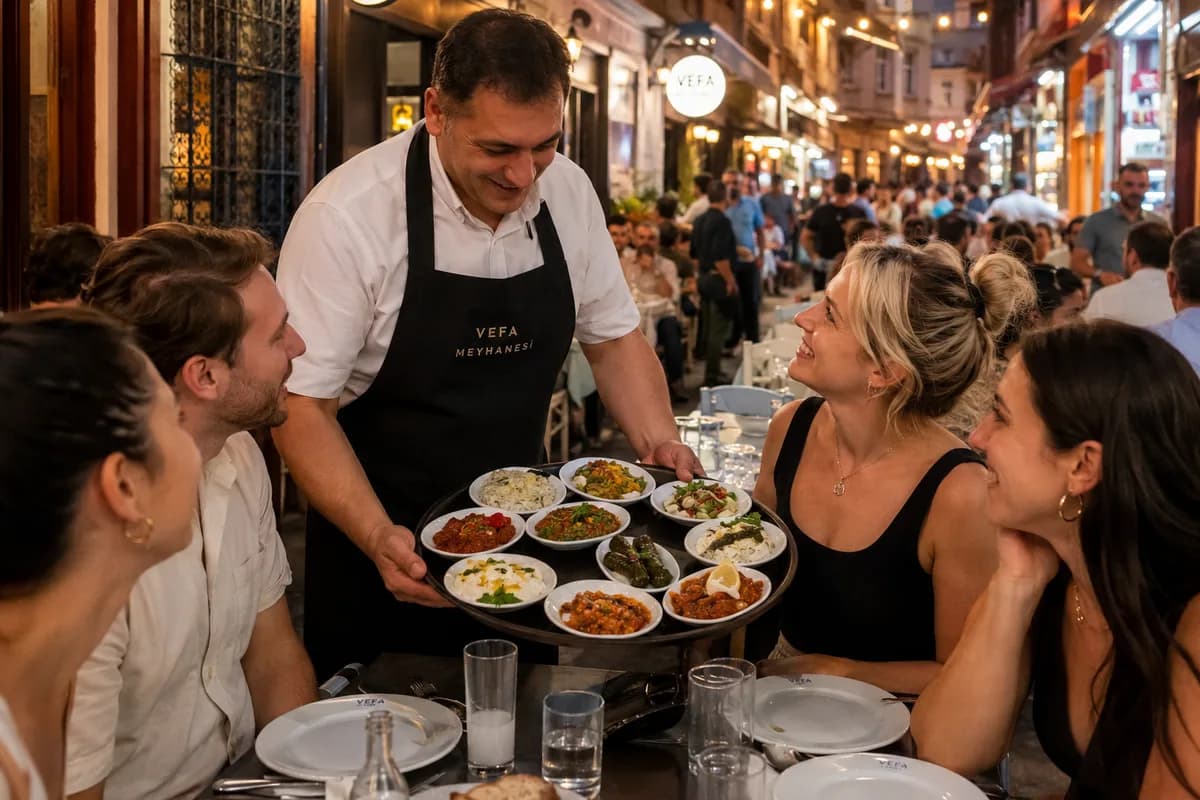
🌍 Istanbul & Anatolia: A Multicultural Vegan Meze Table
Istanbul is home to several civilisations and dozens of ethnic groups. Istanbul cuisine is shaped by multicultural history. Meze tables are the best illustration of this multi-cultural heritage. Here is Veganistanbul.com guide to a rich heritage of Istanbul mezes
A meze table in Istanbul tells a much bigger story than the dishes on it.
For centuries, Turkish, Greek (Rum), Armenian, Sephardic Jewish, Arab/Levantine, Kurdish, Circassian and other communities have cooked side by side across Istanbul and Anatolia. Recipes travelled between neighborhoods, islands, ports and family kitchens changing along the way.
That is why assigning a single nationality to every meze can be misleading. Some have particularly strong roots in one community, while others belong to a shared culinary heritage stretching across Anatolia, the Aegean, the Balkans, the Caucasus and the Eastern Mediterranean.
Here are some of the vegan and vegetarian dishes that tell that story. 👇
🇦🇲 TOPİK
🌱 TOPİK
Istanbul Armenian tradition
Chickpea and potato wrapped around a rich filling of slow-cooked onions, tahini, spices and often currants and pine nuts.
🌱 Usually vegan
📍 One of the most distinctive dishes of Istanbul's historic Armenian cuisine.
⚠️ May contain nuts or pine nuts.
🇦🇲 PATLICAN SALATASI
🍆 ROASTED EGGPLANT SALAD
Armenian & Anatolian traditions
Smoky roasted eggplant dressed with olive oil and lemon, sometimes with peppers, tomatoes or garlic.
🌱 Can be vegan
⚠️ Some versions contain yogurt.
🇹🇷 Ask: “Yoğurt var mı?”
Does it contain yogurt?
🇦🇲 FASULYE PİYAZI
🫘 BEAN PIYAZ
A shared Istanbul & Anatolian tradition
White beans with onion, parsley and a sharp dressing. Recipes differ considerably across Turkey.
🌱 Can be vegan
⚠️ Some versions are topped with boiled egg. Antalya-style piyaz typically contains tahini.
🇬🇷 FAVA
🫛 FAVA
Aegean, Rum & Greek traditions
A silky legume purée served cold with olive oil, onion and herbs.
🌱 Usually vegan
💡 A classic example of the shared food culture found on both sides of the Aegean.
🇬🇷 DENİZ BÖRÜLCESİ
🌊 SAMPHIRE SALAD
Aegean tradition
Salty coastal greens served with olive oil, lemon and often garlic.
🌱 Usually vegan
💡 Particularly at home on the meze tables of Turkey's Aegean coast.
🇬🇷 ŞAKŞUKA
🍆 ŞAKŞUKA
Aegean & Eastern Mediterranean tradition
Fried or sautéed eggplant and other vegetables served with a rich tomato sauce.
🌱 Usually vegan
⚠️ Some restaurants serve it with yogurt.
💡 Its relatives and variations can be found across the wider Mediterranean.
🇬🇷 CACIK / TZATZIKI
🥒 CACIK
A shared Aegean & Eastern Mediterranean tradition
Yogurt, cucumber, garlic and herbs make this one of the region's most recognizable cold dishes.
🥬 Vegetarian ❌ Not vegan — contains yogurt
🇹🇷 In Turkey, you'll usually see it as cacık.
🇬🇷 TARAMA
🐟 TARAMA
Rum, Greek & regional meze tradition
A creamy, salty spread made with fish roe.
❌ Not vegan ❌ Not vegetarian
⚠️ It looks like a vegetable or dairy-based dip, so plant-based travelers should know what it contains.
✡️ AVRAMILA
🌿 AVRAMILA
Istanbul Sephardic Jewish tradition
A lesser-known taste from Istanbul's Sephardic culinary heritage, traditionally prepared with vegetables and fruit such as celery and quince.
🌱 Often vegan
💡 Look beyond the famous mezze: Istanbul's Sephardic kitchens are an important part of the city's food history.
✡️ ALMODROTE DE BERENCENA
🍆 ALMODROTE DE BERENCENA
Sephardic Jewish tradition
A rich baked eggplant dish traditionally combined with cheese.
🥬 Vegetarian ❌ Not vegan
💡 Eggplant has a particularly important place in Sephardic cooking.
✡️ AGRISTADA WITH VEGETABLES
🍋 AGRISTADA
Sephardic Jewish tradition
A distinctive sour sauce from Sephardic cuisine that can accompany vegetables and other dishes.
🥬 Recipe dependent
⚠️ Traditional versions may contain egg, so don't assume it is vegan.
🌙 HUMUS
🧆 HUMMUS
Arab & Levantine tradition
Chickpeas blended with tahini, lemon and garlic into one of the Eastern Mediterranean's best-known mezze.
🌱 Usually vegan
⚠️ In Turkey, occasionally check whether butter has been poured on top.
🇹🇷 Ask: “Üzerinde tereyağı var mı?”
Is there butter on top?
🌙 MUHAMMARA
🌶️ MUHAMMARA
Levantine / Aleppo–Antakya tradition
A rich spread built around red peppers, walnuts and spices, with variations across the region.
🌱 Usually vegan
⚠️ Contains walnuts.
📍 Particularly associated with the culinary world connecting Aleppo and Antakya.
🌙 MÜTEBBEL
🍆 MÜTEBBEL
Arab & Levantine tradition
Smoky roasted eggplant combined with tahini, lemon and garlic.
🌱 Can be vegan
⚠️ Turkish restaurant versions may sometimes contain yogurt.
🇹🇷 Ask: “İçinde yoğurt var mı?”
Does it contain yogurt?
🌙 BABAGANNUŞ
🔥 BABAGANNUŞ
Arab, Levantine & Southeastern Anatolian traditions
Smoky eggplant forms the heart of this famous regional meze, but recipes and even the meaning of the name change from place to place.
🌱 Can be vegan
⚠️ Some Turkish versions contain yogurt.
Always ask before ordering.
🌙 TABBOULEH
🌿 TABBOULEH
Levantine tradition
A bright combination of parsley, tomato, lemon and bulgur, dressed with olive oil.
🌱 Usually vegan
⚠️ Not gluten-free. bulgur is wheat.
💡 The balance of parsley and bulgur changes as you move around the region.
🌙 ZAHTER SALATASI
🌿 ZAHTER SALAD
Antakya & Levantine tradition
Fresh zahter combined with ingredients such as onion, sumac, pomegranate molasses and olive oil.
🌱 Usually vegan
📍 A particularly characteristic taste of Hatay and Antakya's multicultural cuisine.
🟢 ACILI EZME
🌶️ ACILI EZME
Southeastern Anatolian tradition
Finely chopped tomatoes, peppers, onion and herbs seasoned with spices and often pomegranate molasses.
🌱 Usually vegan
🔥 It can be seriously spicy.
💡 Rather than belonging neatly to one community, it reflects the shared food culture of southeastern Anatolia.
🟢 KURU PATLICAN & BİBER DOLMASI
🍆 DRIED EGGPLANT & PEPPER DOLMA
Southeastern Anatolian tradition
Sun-dried eggplants and peppers stuffed with a strongly seasoned rice mixture.
🌱 The meatless version can be vegan
⚠️ Many versions contain meat.
🇹🇷 Ask: “Bu dolma etsiz mi?”
Is this dolma meatless?
💡 Found across Kurdish, Arab and Turkish culinary traditions in southeastern Anatolia.
🟢 KENGER
🌿 KENGER
Eastern & Southeastern Anatolian tradition
A wild edible plant used in regional cooking and sometimes served as a salad or cold dish.
🌱 Can be vegan
⚠️ It is also commonly prepared with yogurt.
💡 Kenger is particularly associated with the food cultures of eastern and southeastern Anatolia, including Kurdish regional cooking.
🟢GAVURDAĞI-STYLE SALAD
🍅 GAVURDAĞI SALATASI
Southeastern Anatolian tradition
Finely chopped tomato, onion and herbs with walnuts, sumac and often pomegranate molasses.
🌱 Usually vegan
⚠️ Contains walnuts.
💡 Better understood as part of southeastern Anatolia's shared regional cuisine than assigned to a single ethnic tradition.
🟦 ÇERKES FASULYESİ
🫘 CIRCASSIAN-STYLE BEANS
Circassian tradition
Beans combined with the rich walnut flavors characteristic of many Circassian dishes.
🌱 Can be vegan
⚠️ Recipes vary and some versions may contain egg or dairy.
🌰 Check for walnuts and other nuts if you have allergies.
🟦 CEVİZLİ SEBZE EZMELERİ
🌰 VEGETABLE & WALNUT SPREADS
Circassian tradition
Vegetables and walnuts come together in a family of intensely flavored spreads and cold dishes.
🌱 Can be vegan
⚠️ Ingredients vary from recipe to recipe, so check for dairy or egg.
💡 Walnuts are one of the signatures of Circassian cooking.
🇹🇷 ONE TABLE, MANY STORIES
🌍 ISTANBUL & ANATOLIA'S MULTICULTURAL MEZE TABLE
🇦🇲 Armenian
🇬🇷 Rum & Greek
✡️ Sephardic Jewish
🌙 Arab & Levantine
🟢 Kurdish & Southeastern Anatolian
🟦 Circassian
🇹🇷 Turkish & Anatolian
Centuries of migration, trade, neighborhood life and shared kitchens have created a food culture where recipes rarely stop at modern borders.
Some dishes have clear connections to particular communities. Others are shared by several cultures.
So rather than asking:
“Who owns this dish?”
Perhaps the better question is:
“What does this dish tell us about the people who shared this city and this land?”
🌱 And for vegan travelers, one rule still matters:
🇹🇷 “Bu meze tamamen vegan mı? İçinde süt, yoğurt, peynir, yumurta veya tereyağı var mı?”
“Is this meze completely vegan? Does it contain milk, yogurt, cheese, egg or butter?”
VeganIstanbul.com
Last reviewed: September 02, 2026