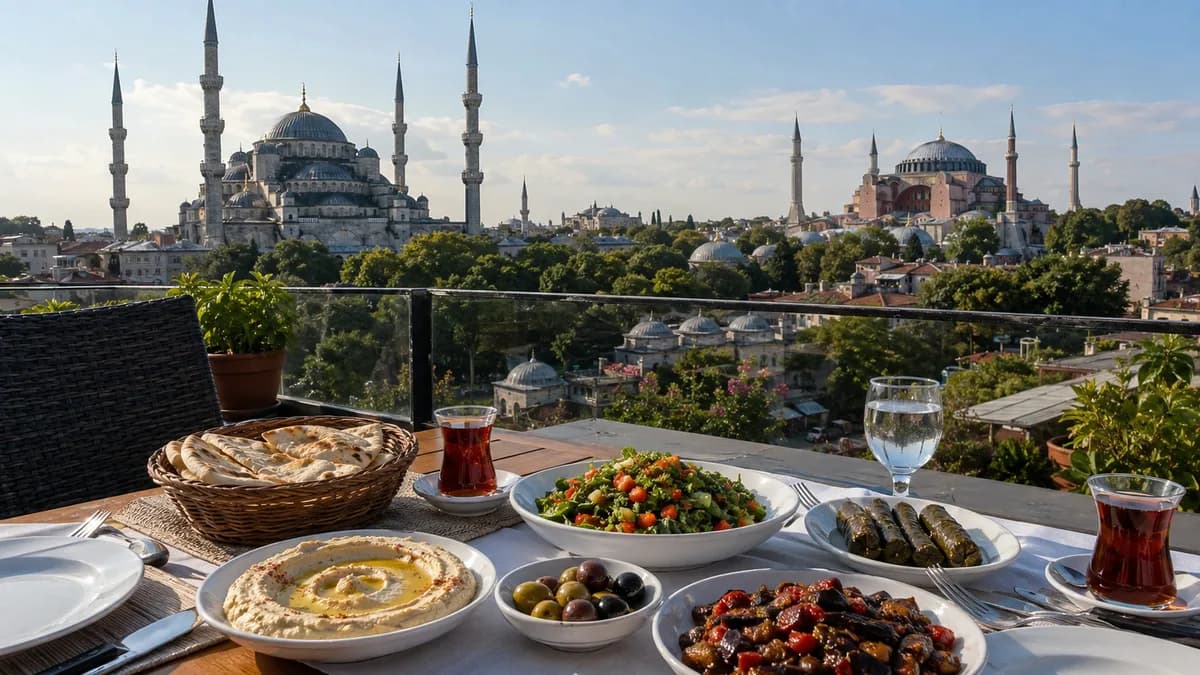
Vegan Istanbul by Neighborhood: Sultanahmet - Two Empires, One Vegan Day
Walk through the Eastern Roman and Ottoman capitals, eat carefully in Istanbul's Old City, and know when to use the tram for a stronger vegan meal
Walk through the Eastern Roman and Ottoman capitals, eat carefully in Istanbul's Old City, and know when to use the tram for a stronger vegan meal.
Sultanahmet is Istanbul at its most concentrated. Within a few streets, you can stand in a Roman chariot-racing ground, enter two of the world’s most recognisable religious buildings, descend into a sixth-century reservoir and walk through the gates of an Ottoman palace.
It is also one of central Istanbul’s least reliable areas for spontaneous vegan dining. That does not make Sultanahmet a bad choice for vegan travellers; it simply means the food needs as much planning as the monuments.
The district forms part of the UNESCO-listed Historic Areas of Istanbul, where Eastern Roman and Ottoman monuments share the same urban landscape. Use this guide to experience those layers without losing half your day to restaurant searches.
Save this route 📌
Morning: Hippodrome → Blue Mosque → Hagia Sophia → Basilica Cistern Lunch: Amedros or Dubb Indian Restaurant Afternoon: Topkapı Palace or the Grand Bazaar–Süleymaniye–Vefa walk Dinner escape: T1 tram to Sirkeci for vegan mantı, or Karaköy for wider plant-based choice
Best for: First-time visitors Transport: Mostly walking; T1 tram for the final meal Important: Choose one afternoon route. Topkapı Palace and the Vefa walk both deserve time; forcing both into one day turns the visit into a checklist.
1. Begin where Constantinople gathered: the Hippodrome
Start early in Sultanahmet Square, before tour groups fill the open space between Hagia Sophia and the Blue Mosque.
The long public garden beside the mosque follows the course of the ancient Hippodrome. Chariot races were the spectacle, but this was also where imperial ceremony, public celebration and political conflict played out.
Three monuments once positioned along the arena’s central barrier still survive: the Obelisk of Theodosius, brought from Egypt; the bronze Serpent Column, originally dedicated at Delphi; and the Walled Obelisk. The Hippodrome guide from GoTürkiye provides a useful introduction.
Look down the length of the square rather than only at the monuments. Its shape makes much more sense once you imagine racing teams turning at either end and tens of thousands of spectators rising on terraces around them.
2. Read the Blue Mosque through its tiles
The official name of the Blue Mosque is the Sultan Ahmed Mosque, and the surrounding neighbourhood took the sultan’s name.
Built in the early 17th century, the mosque is known for its six minarets and an interior covered with thousands of tiles in the İznik tradition. The blue is not a single colour wash; it appears through floral patterns, filtered daylight and the repetition of glazed tiles. See the GoTürkiye Blue Mosque guide for background.
This is an active mosque, not simply a monument. Non-worshippers cannot enter during prayers. Dress modestly, remove your shoes and carry a scarf if needed. Checking the day’s prayer times before setting out can prevent a long wait.
3. Cross the square — and nearly 1,500 years
Directly opposite stands Hagia Sophia, completed in 537 under Emperor Justinian I. Designed by Anthemios of Tralles and Isidoros of Miletus, it became a model for later churches and mosques.
It served as a cathedral, became a mosque after the Ottoman conquest in 1453, operated as a museum from 1935 and became a mosque again in 2020.
Do not rush straight to the dome. Notice how different periods remain visible at once: Byzantine mosaics, Ottoman calligraphy, minarets, buttresses and later repairs all belong to the same building. Restoration work may affect the visitor route and some views, so check current access before visiting.
4. Go underground at the Basilica Cistern
A few minutes away, the Basilica Cistern reveals the infrastructure behind the imperial city.
Built during Justinian’s reign, the vast underground reservoir is supported by more than 300 marble columns, many reused from earlier structures. Two Medusa heads, placed beneath columns at the far end, are its most famous details. Read more in the GoTürkiye Basilica Cistern guide.
The cistern is usually crowded around midday. Visiting before lunch also gives the day a natural historical sequence: public arena, places of worship, then the water system that helped sustain the city around them.
5. Lunch: choose certainty, proximity or local character
Sultanahmet still has no dense cluster of dedicated vegan restaurants. These are the most practical choices from the VeganIstanbul.com database, but they offer different levels of certainty.
Best all-round choice: Amedros Cafe Restaurant
Amedros Cafe Restaurant is a short walk from the main square and is listed by VeganIstanbul.com under Turkish, Ottoman, international and vegan cuisine.
The restaurant advertises vegan and gluten-free choices, making it the easiest nearby option when you want staff to understand the request without a long negotiation.
Look for vegetable casseroles or clay-pot dishes, hummus, meze and other explicitly marked plant-based plates. Because this is a mixed kitchen, still ask whether rice, soup or sauce contains meat stock, butter or yoghurt. A “vegetable dish” is not automatically vegan in a Turkish restaurant.
Best close alternative: Dubb Indian Restaurant
Dubb Indian Restaurant — Sultanahmet is close to Hagia Sophia and useful when you want a legume-based meal rather than another generic tourist menu.
The current Dubb menu includes potentially adaptable dishes such as chana masala, dal tarka, zeera aloo, pakora and several rice dishes. Ask for your order without ghee, butter, cream or yoghurt.
One important warning: vegetarian does not mean vegan here. Dubb’s vegetarian thali currently includes paneer, yoghurt and a milk-based dessert. Dal makhani is also traditionally made with butter and cream. Order individual dishes and confirm their preparation instead of assuming the vegetarian set can be served unchanged.
Most local, but requiring more questions: Sefa Restaurant
Sefa Restaurant, near Nuruosmaniye and Çemberlitaş, offers the experience of choosing from the counter at a traditional Turkish lokanta.
Seasonal zeytinyağlı dishes, vegetables cooked with olive oil — can produce a more recognisably local lunch than the restaurants around the main square.
This is not a vegan kitchen, and the day’s display changes. Ask separately about butter, meat stock and yoghurt. Lentil soup, rice and even vegetable dishes can contain one of them. Treat Sefa as the more culturally interesting option, not the most predictable one.
6. Choose your afternoon
Route A: The imperial court, Topkapı Palace and Gülhane
Choose this route if political and court history is your priority.
Built from the 15th century onward, Topkapı Palace served as the centre of Ottoman rule and the sultans’ residence for centuries. Its courtyards make the logic of the court visible: access becomes more restricted as you move inward, from the public and administrative spaces toward the private palace.
Allow at least two to three hours if you also want to see the Harem and Treasury. The GoTürkiye Topkapı Palace guide outlines its history.
After the palace, descend past the Istanbul Archaeological Museums toward Gülhane Park, once part of the palace grounds, and continue to Sirkeci. This positions you well for the T1 tram and dinner.
Route B: Markets, mosque courtyards and a historic drink
Choose this route if you prefer street life and food history.
Follow Divanyolu toward Çemberlitaş, enter the Grand Bazaar through the Nuruosmaniye side, then continue uphill to the Süleymaniye Mosque. This walk moves away from Sultanahmet’s tour group economy and into the commercial and residential fabric of the Historic Peninsula.
Finish at Vefa Bozacısı, established in 1876.
Boza is a thick, sweet-tart fermented grain drink traditionally served with cinnamon and roasted chickpeas. Its standard ingredients are plant-based, but strict vegans should still confirm the current product and toppings.
It is especially associated with colder weather and offers something the original Sultanahmet restaurant list lacks: a genuine taste of Istanbul’s urban food history.
7. When Sultanahmet’s menus are not enough, use the tram
The T1 line is the vegan traveller’s easiest exit route from the Old City. From Sultanahmet, Gülhane, Sirkeci, Eminönü and Karaköy follow in sequence toward Kabataş; see the official Metro Istanbul T1 station list.
Two stops: Sirkeci for vegan mantı
Mr.Dumpling Sirkeci offers vegan versions of mantı, the small filled dumplings usually served with garlic yoghurt and butter.
This is a useful way to try a recognisably Turkish dish in plant-based form. Confirm that your filling and every sauce are vegan, especially if different versions are prepared in the same kitchen.
Four stops: Karaköy for more choice
Crossing the Galata Bridge on the tram changes the evening completely.
Tahin Karaköy serves Lebanese and Middle Eastern food with vegan and vegetarian options, making mezze, falafel and tahini-based plates easier to navigate.
Vacilando is another option for vegan and gluten-free café food, toast and lighter plates.
For a cheaper bowl, Karaköy Çorba Evi serves a rotating soup selection. Ask which soups are made without meat stock, butter, cream or yoghurt; mercimek çorbası is not automatically vegan.
What about Esto and Zeferan?
Both remain useful for vegetarians or mixed-diet groups, but neither should lead a vegan itinerary.
Esto Restaurant is vegetarian-friendly, yet its current VeganIstanbul.com entry does not identify specific vegan dishes. Menemen contains egg and muhlama is based on butter and cheese, so neither belongs on a vegan recommendation list.
Zeferan Restaurant offers Azerbaijani cuisine in a higher-priced hotel setting. Pilafs may contain butter, and pastry-wrapped rice dishes require ingredient checks. Consider it for a mixed group, not as the safest vegan meal near the monuments.
The four questions that prevent most mistakes 🌱
Show or say this when ordering:
Veganım. Et, tavuk, balık, süt, yoğurt, peynir, tereyağı, yumurta ve bal yemiyorum. Et suyu da kullanmayın, lütfen.
I’m vegan. I don’t eat meat, chicken, fish, milk, yoghurt, cheese, butter, eggs or honey. Please do not use meat stock either.
Then confirm:
- Is there butter or ghee in the rice or sauce?
- Is the soup made with meat or chicken stock?
- Does the bread contain milk, yoghurt or egg?
- Is the fryer shared with meat or cheese products?
The honest verdict
Sultanahmet is a world-class history district with workable vegan options, not a vegan dining neighbourhood.
Its strength lies in the route: Roman spectacle at the Hippodrome, Byzantine engineering at Hagia Sophia and the cistern, Ottoman ceremony at the Blue Mosque and Topkapı, then either boza in Vefa or a tram ride to a stronger plant-based dinner.
Plan one reliable meal, keep the T1 line in reserve and let the history set the pace.
📌 Save this for your Istanbul trip. Tag another vegan or vegetarian traveler who needs it.
Last reviewed: August 25, 2026, Menus, product availability, and operating hours may change. Before visiting, contact the venue to confirm the accuracy of the information.