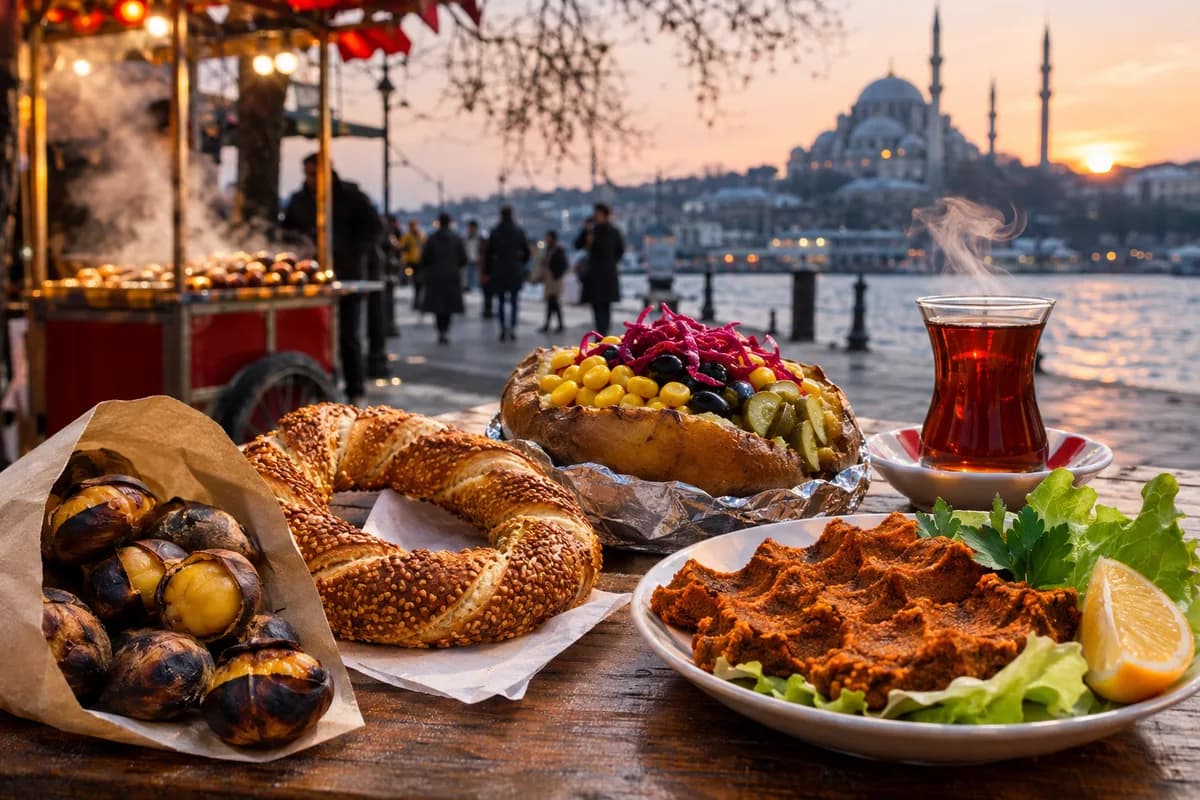
❄️ Vegan Winter Street Food in Istanbul: What to Eat on Cold Days
🌰 Roasted chestnuts, sesame-covered simit, steaming potatoes and traditional winter drinks. Istanbul's colder months bring a different street-food experience
Here's what vegan travellers can enjoy, where to look and what to avoid.
Winter changes the rhythm of Istanbul's streets. Chestnut sellers gather around glowing roasting pans, bakeries fill their windows with freshly baked bread, and small food counters offer warm snacks to people escaping the cold.
For vegan visitors, winter street food offers several possibilities. Some traditional favourites are naturally plant-based, while others require a few questions before ordering.
Here are 10 foods, snacks and drinks to look for during an Istanbul winter, including a few that are available year-round but particularly welcome on cold days.
🌰 1. Kestane: Roasted Chestnuts
🌱 Usually vegan | ❄️ A winter favourite
Follow the smell of roasting chestnuts.
Known locally as kestane, these are roasted in their shells on large metal pans, often over charcoal or gas flames. Vendors sell them in small paper bags.
The traditional preparation requires just chestnuts and heat, making them one of the simplest vegan street snacks.
📍 Where to find them: Look for chestnut carts around Taksim Square, İstiklal Avenue, Eminönü and Kadıköy's busy shopping streets.
💡 Vegan tip: Plain roasted chestnuts are naturally plant-based. Check if any additional flavourings or coatings are used.
🥯 2. Simit: Istanbul's Sesame Bread Ring
🌱 Usually vegan | 🥨 Available year-round
Few foods are as closely associated with Istanbul's everyday street life as simit.
This circular bread, covered with sesame seeds, has a crisp exterior and chewy centre. Traditional Istanbul simit is prepared with flour, water, yeast, salt, grape molasses and sesame.
It is sold from red street carts, neighbourhood bakeries and small takeaway shops.
During winter, freshly baked simit and a glass of hot Turkish tea make a convenient breakfast or afternoon snack.
📍 Where to find it: Almost everywhere, particularly near ferry terminals, public transport stations and busy squares.
⚠️ Vegan warning: Traditional simit is generally vegan, but some bakery variations contain milk, butter or eggs. Check the ingredients.
🥔 3. Kumpir: A Giant Baked Potato
🌱 Vegan if modified | 🔥 Served hot
Imagine a large potato baked until its skin becomes crisp and its centre turns soft.
That's kumpir, one of Istanbul's substantial street-food options.
The potato is opened, mashed and mixed with ingredients before being piled high with toppings.
Here's the catch: traditional kumpir usually contains butter and kaşar cheese mixed directly into the potato.
Vegans need to request a different preparation before the vendor starts mixing.
Choose suitable toppings such as:
- Sweetcorn
- Black or green olives
- Pickled cucumbers
- Pickled red cabbage
- Plain cooked vegetables
Avoid mayonnaise, yogurt-based salads and other creamy toppings unless their ingredients are confirmed vegan.
📍 Where to find it: Ortaköy, a neighbourhood on the European shore of the Bosphorus, is particularly associated with kumpir. Baked-potato counters also operate elsewhere in Istanbul.
🗣️ Say: “Tereyağı ve kaşar peyniri koymayın, lütfen.”
Please don't add butter or cheese.
💡 Ask the seller to prepare your potato separately with clean utensils if the usual mixing equipment is covered in butter or cheese.
🌯 4. Etsiz Çiğ Köfte: A Spicy Bulgur Wrap
🌱 Often vegan | 🌶️ Available year-round
Despite its name, etsiz çiğ köfte is a meat-free speciality made primarily from fine bulgur, pepper paste, tomato paste and spices.
It is usually served in lettuce leaves or wrapped in thin flatbread with fresh herbs and lemon.
The spicy mixture offers a substantial snack for visitors who want something more filling than roasted chestnuts.
Although served cold or at room temperature, it remains a practical winter takeaway.
📍 Where to find it: Small çiğ köfte shops are common throughout Istanbul, including residential neighbourhoods and shopping streets.
⚠️ Vegan warning: Ask whether the mixture, wrap and sauces are entirely plant-based. Avoid yogurt-based sauces.
🫓 5. Patatesli Gözleme: Turkish Potato Flatbread
🌱 Vegan if prepared correctly | 🔥 Best eaten hot
Gözleme is a thin Turkish flatbread folded around a filling and cooked on a hot metal griddle.
For vegans, the potato-filled version, patatesli gözleme, can be an option.
The filling typically combines mashed potatoes with onions, spices and sometimes herbs.
But don't assume that a vegetable filling guarantees a vegan dish.
Some cooks use dairy products in the dough, add butter during cooking or mix cheese into vegetable fillings.
📍 Where to find it: Traditional food markets, casual eateries and some bakery-style takeaway counters. Gözleme is less ubiquitous on Istanbul's streets than simit or chestnuts.
🗣️ Ask: “Hamurunda veya içinde süt, peynir, tereyağı ya da yumurta var mı?”
Does the dough or filling contain milk, cheese, butter or eggs?
🌽 6. Sıcak Mısır: Hot Corn on the Cob
🌱 Vegan when served plain | 🌽 Available beyond summer
Although corn is often associated with summer, boiled and grilled corn can also be found during colder months.
Street vendors sell whole corn cobs, while some shops offer corn kernels in cups.
Plain boiled or grilled corn is plant-based.
However, corn in cups may be mixed with butter, mayonnaise or flavoured sauces.
📍 Where to find it: Street carts in busy tourist districts and shopping areas, depending on the season and vendor.
🗣️ Say: “Sade olsun, tereyağı olmasın.”
Plain, please. No butter.
🥟 7. Patatesli Börek: Potato-Filled Pastry
🌱 Sometimes vegan | 🥐 Check carefully
Winter mornings in Istanbul often begin at neighbourhood bakeries.
One familiar choice is börek, a pastry made from thin layers of dough with various fillings.
Potato-filled börek can be vegan when the pastry is prepared without animal products.
But many varieties contain butter, milk, yogurt or eggs, even when the filling itself is entirely vegetable-based.
Some bakeries also brush pastries with egg before baking.
📍 Where to find it: Neighbourhood börek shops and traditional bakeries, particularly in the morning.
⚠️ Vegan warning: Ask about both the dough and the cooking fat. Don't assume that patatesli, meaning potato-filled, guarantees a vegan pastry.
🍩 8. Lokma: Warm Fried Dough in Syrup
🌱 Sometimes vegan | 🍯 A sweet street treat
For visitors looking for something sweet, lokma is worth investigating.
These small pieces of fried dough are soaked in sweet syrup and served in portions.
Traditional recipes can be made with flour, yeast, water, sugar and vegetable oil.
However, recipes vary. Some preparations include dairy or eggs, while certain toppings contain milk chocolate, cream or honey.
📍 Where to find it: Dessert counters, specialist lokma shops and occasional street stalls.
💡 Vegan tip: Ask about the dough, syrup, toppings and frying oil. Plain lokma is a better starting point than versions covered with creamy sauces.
☕ What to Drink on a Cold Istanbul Day
Winter street food isn't just about eating. Istanbul has its own seasonal drinking traditions.
🥣 9. Boza: Istanbul's Traditional Winter Drink
🌱 Traditionally plant-based | ❄️ A winter speciality
Boza is one of Istanbul's distinctive cold-weather traditions.
Made from fermented grains, it has a thick consistency, a mildly sweet flavour and a slightly tangy finish.
Despite its association with winter, boza is traditionally served cold, often with cinnamon and roasted chickpeas called leblebi.
Unlike many modern milk-based drinks, traditional boza recipes use plant-based ingredients.
📍 Where to find it: Traditional boza shops, particularly in older neighbourhoods. The historic Vefa district in Fatih is associated with Istanbul's boza culture.
⚠️ Vegan warning: Check the ingredients of commercial varieties and any toppings. Boza is fermented and may contain trace amounts of alcohol.
🫖 10. Turkish Tea: The Simplest Winter Companion
🌱 Vegan | ☕ Served hot
Turkish black tea, known as çay, is part of daily life in Istanbul.
It is brewed in a two-part teapot and served in small, tulip-shaped glasses, usually without milk.
You can enjoy it with a simit at a bakery, beside a ferry terminal or while resting after a long walk.
📍 Where to find it: Tea shops, bakeries, cafés, ferry services and countless small businesses.
💡 Vegan tip: Traditional Turkish tea contains no dairy. Sugar is usually offered separately.
⚠️ The Winter Trap: Salep Is Usually Not Vegan
You will notice another drink appearing on menus as temperatures fall: salep.
This thick, hot drink is traditionally made with milk, sugar and powder derived from orchid tubers.
Although the powder itself comes from plants, traditional salep is prepared with cow's milk.
A vegan version requires plant-based milk and a dairy-free salep mixture.
Similarly, hot chocolate and other winter drinks may contain milk powder even when prepared with water.
Always check before ordering.
📍 Where to Explore Istanbul's Winter Street Food
Rather than searching for one particular restaurant, explore neighbourhoods where traditional street vendors, bakeries and takeaway counters operate.
🌰 İstiklal Avenue and Taksim: In the European-side district of Beyoğlu, this pedestrian shopping street is a familiar place to look for roasted chestnuts, simit and small takeaway snacks.
🥔 Ortaköy: On the European shore of the Bosphorus, Ortaköy is associated with baked-potato stalls. It is particularly useful for visitors interested in trying a modified vegan kumpir.
🥯 Eminönü and Sirkeci: These busy transport and commercial areas in the Historic Peninsula offer opportunities to find simit, tea, roasted chestnuts and bakery snacks.
🥣 Vefa and Fatih: Explore older neighbourhoods for traditional boza shops. Vefa is within the wider Historic Peninsula, away from the busiest waterfront tourist streets.
🌽 Kadıköy: On Istanbul's Asian side, the streets around the market and Bahariye shopping area are places to look for traditional snacks, bakeries and seasonal vendors.
Street-vendor locations and seasonal availability change, so treat these as areas to explore rather than guaranteed selling points.
🗣️ Essential Turkish for Vegan Street Food
You don't need to speak fluent Turkish to order vegan food in Istanbul. A few sentences can prevent common mistakes.
🌱 “Bu tamamen vegan mı?”
Is this completely vegan?
🧈 “İçinde tereyağı var mı?”
Does it contain butter?
🥛 “Süt, peynir veya yumurta var mı?”
Does it contain milk, cheese or eggs?
🥩 “Et suyu veya tavuk suyu kullanılıyor mu?”
Is meat or chicken stock used?
🍯 “İçinde bal var mı?”
Does it contain honey?
🫒 “Sadece zeytinyağı veya bitkisel yağ kullanıyor musunuz?”
Do you use only olive oil or vegetable oil?
Remember that etsiz means meat-free, not necessarily vegan.
❄️ A Final Tip for Winter Visitors
Istanbul's winter street food is not necessarily about finding a vegan version of every Turkish speciality.
Some of the simplest traditional snacks, particularly roasted chestnuts and simit, already fit into a plant-based diet when prepared according to their customary recipes.
Others, including kumpir, gözleme and börek, require more attention.
Choose freshly prepared food, ask about ingredients and check how dishes are cooked. If you have food allergies or celiac disease, also ask about shared equipment and cross-contact.
And remember, a food being vegetarian or meat-free does not automatically make it vegan.
For more practical information, explore the street-food and traditional Turkish food guides at veganistanbul.com.
Winter in Istanbul offers more than hot drinks and roasted chestnuts. Sometimes the best discovery is a simple local snack that has been plant-based for generations.