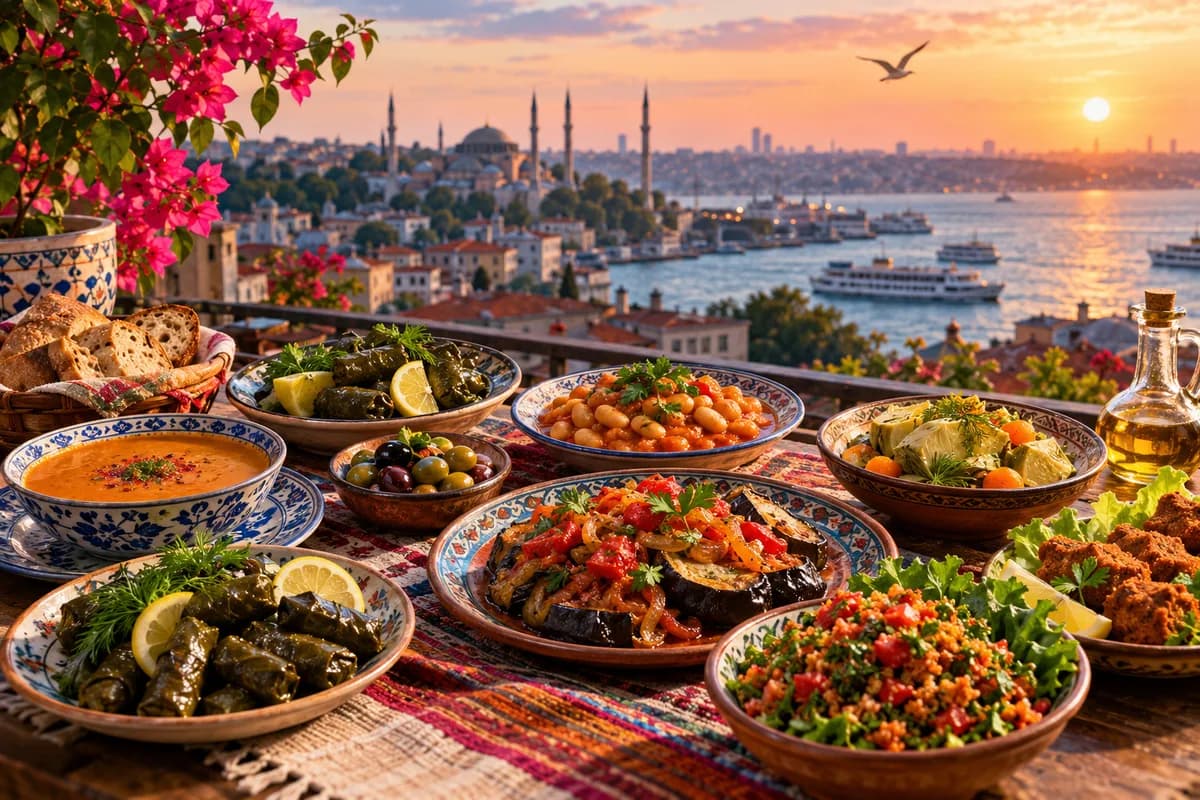
🌍 Istanbul’s Multicultural Kitchen: The Vegan and Vegetarian Heritage of Everyday Meals
From Armenian family kitchens and Sephardic Jewish recipes to Greek vegetable dishes, Balkan pastries and Anatolian stews, Istanbul’s everyday food tells the story of a city shaped by many cultures. For vegan and vegetarian visitors, that history offers much more than meze
A pot of beans simmering in olive oil. Stuffed peppers filled with rice and herbs. A steaming bowl of lentil soup. Spinach cooked with onions, or a tray of vegetables fresh from the oven.
These ordinary dishes reveal something remarkable about Istanbul: Much of its multicultural culinary heritage is built around vegetables, grains and legumes.
Long before veganism became a modern dietary choice, Istanbul’s communities were preparing meatless meals for reasons ranging from religious observance and seasonal availability to household budgets and family traditions.
The city's cuisine developed through centuries of interaction among Byzantine, Ottoman, Anatolian, Balkan, Caucasian and Eastern Mediterranean food cultures.
Research into Istanbul’s minority cuisines identifies the contributions of Rum (Greek), Armenian and Sephardic Jewish communities as important elements of this shared culinary history.
For visitors, discovering these traditions means looking beyond kebabs, seafood and even the famous meze table.
🇬🇷 1. Rum and Greek Kitchens: Vegetables, Olive Oil and Religious Fasting
🌱 Try: İmam bayıldı, fasulye pilaki, spinach with rice and stuffed vegetables.
Istanbul’s historic Rum community, the city's Greek Orthodox population, contributed to a culinary tradition in which vegetables, olive oil, greens and legumes have long played important roles.
Orthodox Christian fasting practices also encouraged the preparation of dishes without meat and, during certain fasting periods, without dairy or eggs.
One familiar example is fasulye pilaki, white beans slowly cooked with olive oil, onions, carrots and tomatoes.
Another is ıspanaklı pilav, rice cooked with spinach and herbs, related to vegetable-and-rice dishes found across the Aegean.
🍆 İmam bayıldı, an eggplant dish cooked with onions, tomatoes and olive oil, belongs to a broader Ottoman and Eastern Mediterranean tradition rather than exclusively to one community.
🌱 Vegan status: These dishes can be vegan, particularly when prepared with olive oil. Check for butter or meat stock.
🇦🇲 2. Armenian Kitchens: Lentils, Bulgur and Lenten Traditions
🌱 Try: Etsiz yaprak sarma, lentil dishes, stuffed vegetables and topik.
Istanbul Armenian cooking offers another example of how religious observance helped preserve plant-based recipes.
During periods of Armenian Apostolic fasting, families traditionally avoided animal-derived foods, creating opportunities for vegetable, grain and legume dishes.
Rice-filled vine leaves, vegetable stews, lentils and bulgur all have places in this culinary tradition, although many recipes are also shared with other communities.
One particularly recognisable Istanbul Armenian specialty is topik, made with chickpeas, potatoes, tahini, onions and spices.
But Armenian culinary heritage extends well beyond this familiar meze.
Everyday meatless cooking includes stuffed vegetables, vegetable soups and grain-based meals prepared according to family and seasonal traditions.
🌱 Vegan status: Many fasting recipes are naturally vegan. Ordinary versions may contain butter or other animal products.
📖 For a closer look at Armenian culinary traditions, consult Arto der Haroutunian’s Armenian Food.
✡️ 3. Sephardic Jewish Kitchens: Eggplant, Leeks and Seasonal Vegetables
🌱 Try: Eggplant dishes, leek patties, stuffed vegetables and vegetable stews.
Sephardic Jews who settled in the Ottoman Empire after their expulsion from Spain brought culinary traditions that developed further through contact with local ingredients and neighbouring communities.
Eggplant became particularly prominent in Sephardic cooking, appearing in baked dishes, stews and vegetable preparations.
Leeks, spinach, rice and other vegetables also feature in traditional family recipes.
A characteristic example is almodrote de berencena, a baked eggplant dish traditionally prepared with cheese and sometimes eggs.
Another is pırasa, a name associated with leek preparations, including patties that may contain eggs.
These dishes demonstrate an important distinction: a cuisine can have strong vegetable traditions without every vegetable dish being vegan.
🌱 Vegan status: Some vegetable stews are vegan, but traditional almodrote and many leek patties are vegetarian rather than vegan.
📖 Claudia Roden’s The Book of Jewish Food explores Sephardic and other Jewish culinary traditions, including the ways recipes changed as communities migrated.
🥬 4. Balkan Traditions: Cabbage, Beans and Savory Pastries
🌱 Try: Cabbage rolls, bean stews, vegetable börek and roasted peppers.
Migration from the Balkans helped shape Istanbul’s everyday food culture, particularly during the Ottoman period and subsequent population movements.
Cabbage, beans, peppers and savory pastries are common ingredients across Balkan cuisines.
Cabbage sarma, made with leaves wrapped around a rice filling, illustrates the overlap between Balkan and Anatolian home cooking.
Beans cooked with onions and peppers are another familiar example.
Savory pastries also traveled across communities, with fillings ranging from spinach and potatoes to cheese and meat.
The similarities do not necessarily establish where a particular dish originated. Instead, they reveal centuries of culinary exchange.
🌱 Vegan status: Rice-filled cabbage rolls and bean stews can be vegan. Börek frequently contains butter, cheese, eggs or milk.
🌶️ 5. Kurdish, Arab and Southeastern Anatolian Kitchens: Bulgur and Lentils
🌱 Try: Mercimek köftesi, kısır, vegetable stews and bulgur pilaf.
Istanbul’s culinary diversity also reflects migration from southeastern Anatolia, where Kurdish, Arab, Turkish and other communities share overlapping food traditions.
Bulgur, lentils, peppers, herbs and regional spices are particularly important.
Mercimek köftesi, made with red lentils, fine bulgur, onions and spices, is one of the most accessible examples of a traditionally meatless dish.
Kısır, a bulgur salad prepared with herbs, vegetables and tomato or pepper paste, is another.
These foods are not exclusive to any single ethnic community. Their regional variations are part of the wider culinary heritage of southeastern Anatolia.
🌱 Vegan status: Both dishes are usually vegan when prepared with vegetable oil, although some recipes contain butter.
⚠️ Both contain bulgur, which is wheat and therefore unsuitable for people with celiac disease.
🟦 6. Circassian and Caucasian Traditions: Corn, Beans and Vegetables
🌱 Try: Corn-based dishes, bean preparations and vegetable dishes with walnut sauces.
Circassian communities brought culinary traditions from the Caucasus to Ottoman lands, particularly following large-scale migrations during the 19th century.
Cornmeal, beans, walnuts and vegetables feature in different Caucasian food traditions.
Corn-based preparations and vegetable dishes can provide meatless options, although dairy products and meat are also important elements of Circassian cooking.
One of the better-known Circassian dishes in Türkiye is Çerkez tavuğu, a chicken dish prepared with walnuts.
Despite its walnut-based sauce, it is neither vegetarian nor vegan.
🌱 Vegan status: Individual corn, bean and vegetable dishes may be vegan, but ingredients vary considerably.
🇹🇷 7. Anatolian Home Cooking: The Shared Language of the Istanbul Table
🌱 Try: Zeytinyağlı taze fasulye, nohut, kuru fasulye, türlü and mercimek çorbası.
Perhaps the clearest expression of Istanbul’s multicultural food heritage is found in its ordinary neighbourhood restaurants.
An esnaf lokantası is a traditional, usually inexpensive restaurant serving freshly prepared home-style dishes, often displayed in trays behind a counter.
Its menu may include:
🥬 Zeytinyağlı taze fasulye: Green beans cooked with tomatoes and olive oil.
🫘 Kuru fasulye: White beans simmered in tomato sauce.
🍆 Türlü: A vegetable stew commonly prepared with eggplant, potatoes, peppers and other seasonal produce.
🥣 Mercimek çorbası: Red lentil soup, widely eaten across Türkiye.
🍚 Nohutlu pilav: Rice with chickpeas, a familiar everyday combination.
These dishes represent overlapping traditions rather than a single ethnic origin.
Their variations reflect the ingredients, cooking methods and preferences that families brought to Istanbul from across Anatolia and beyond.
🌱 Vegan status: All can be prepared without animal products, but traditional restaurants may use butter, meat, meat stock or chicken stock.
🫒 Why Did Plant-Based Cooking Become So Important?
Istanbul’s vegetable-rich culinary heritage developed for several reasons.
⛪ Religious traditions: Christian fasting practices encouraged meatless and sometimes entirely plant-based cooking. Jewish dietary traditions also influenced food preparation, although kosher food is not necessarily vegetarian.
🌾 Agriculture and seasonality: Vegetables, grains, pulses and preserved foods were important parts of household diets.
💰 Household economics: Meat was not an everyday ingredient for every family. Beans, lentils and grains provided affordable alternatives.
🚢 Migration and trade: Istanbul connected the Balkans, Anatolia, the Black Sea, the Caucasus and the Eastern Mediterranean. People brought ingredients, techniques and family recipes with them.
Food historian Priscilla Mary Işın examines these historical connections in Bountiful Empire: A History of Ottoman Cuisine, while academic research by Özge Samancı documents how Ottoman and Republican-era cookbooks reflect changing food habits.
🌱 What Should Vegan Visitors Know?
Historical meatless recipes are not automatically vegan.
Butter, yogurt, cheese, eggs and meat stock appear in dishes that may otherwise look entirely plant-based.
A useful question in Turkish is:
🇹🇷 “Bu yemek tamamen bitkisel mi? İçinde tereyağı, süt, yoğurt, yumurta veya et suyu var mı?”
Is this dish entirely plant-based? Does it contain butter, milk, yogurt, eggs or meat stock?
For more practical advice, see our guides to vegan Turkish food in Istanbul and Istanbul’s multicultural vegan meze traditions.
🌍 A City Where Recipes Crossed Borders
The most interesting thing about Istanbul’s multicultural kitchen is not deciding which community invented each dish.
It is discovering how generations of families adapted familiar ingredients to their own tastes, beliefs and circumstances.
A stuffed vegetable might appear in an Armenian family kitchen, a Rum household, a Sephardic home or an Anatolian neighbourhood restaurant, with different fillings and seasonings.
The recipes may not be identical. Their histories may be different. But they share the same city.
For vegan and vegetarian visitors, Istanbul’s culinary heritage is not limited to modern plant-based restaurants. Much of it has been simmering in ordinary kitchens for centuries. 🌱