🫒 Zeytinyağlı or Sebzeli? A Vegan Tourist’s Guide to Understanding Turkish Vegetable Dishes
Two Turkish words that sound equally promising to vegans can mean very different things on a restaurant menu. One often points toward traditional plant-based cooking, while the other simply tells you that vegetables are involved. Understanding the difference can save you from ordering the wrong meal in Istanbul
Two Turkish words on a menu can completely change whether a vegetable dish is safe for vegans.
Imagine walking into a traditional Istanbul restaurant. Behind the glass counter, you see eggplants, green beans, spinach, potatoes and colourful vegetable stews.
Everything looks suitable for vegans. But is it?
The answer often depends on two Turkish expressions: zeytinyağlı and sebzeli.
They may appear on the same menu, but they describe different things. And for vegan travelers, that distinction matters.
🫒 1. Zeytinyağlı: A Tradition Built Around Olive Oil
Zeytinyağlı literally means "with olive oil."
However, in Turkish cuisine, it means considerably more than simply adding olive oil to a dish.
Zeytinyağlı refers to a traditional category of dishes prepared primarily with vegetables, legumes, rice, herbs and olive oil.
These dishes are generally cooked without meat and are often served cold or at room temperature, although some may be served warm.
Unlike many vegetable dishes elsewhere, zeytinyağlı preparations are not necessarily side dishes. A generous serving can become the centerpiece of a vegan lunch.
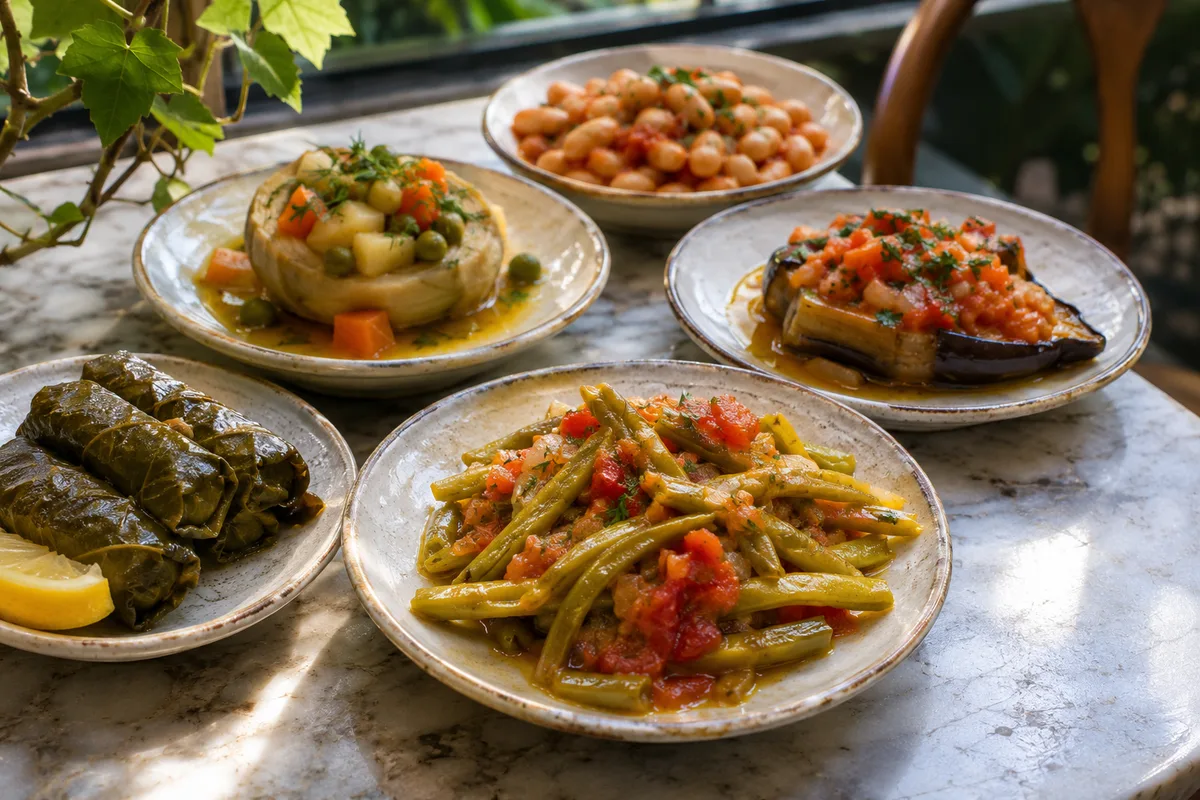
🌱 Common zeytinyağlı dishes in Istanbul
- Zeytinyağlı enginar: Artichokes cooked with olive oil, carrots, potatoes, peas and lemon.
- Zeytinyağlı pırasa: Leeks slowly cooked with carrots, olive oil and sometimes rice.
- Zeytinyağlı taze fasulye: Green beans simmered with tomatoes, onions and olive oil.
- Zeytinyağlı kereviz: Celeriac prepared with olive oil, carrots and citrus.
- Barbunya pilaki: Borlotti beans cooked with olive oil, onions, carrots and tomatoes.
- İmam bayıldı: Eggplant stuffed with onions, tomatoes and garlic, cooked in olive oil.
- Zeytinyağlı yaprak sarma: Vine leaves wrapped around seasoned rice and herbs.
These dishes are generally vegan when prepared according to their traditional meatless recipes.
⚠️ Important: Zeytinyağlı is not an official vegan label. Restaurant recipes can vary, so confirm that no animal-derived ingredients have been added.
For a closer look at this culinary tradition, read our guide to understanding zeytinyağlı dishes.
🥘 2. Sebzeli: Vegetables Are Included, but What Else?
The Turkish word sebze means vegetable.
Sebzeli means "with vegetables" or "containing vegetables."
This is where tourists need to be careful.
Unlike zeytinyağlı, sebzeli does not identify a traditional cooking category or specify which cooking fat is used.
It simply describes an ingredient.
A sebzeli dish might contain vegetables alongside meat, chicken, butter, cheese or other animal products.
Consider these examples:
🥦 Sebzeli makarna: Pasta with vegetables. It might be vegan, but the sauce could contain cream, butter or cheese.
🍚 Sebzeli pilav: Rice with vegetables. It may be cooked with butter or chicken stock.
🍗 Sebzeli tavuk: Chicken with vegetables. Definitely not vegan.
🥘 Sebzeli güveç: A vegetable casserole. It might be entirely plant-based, but some versions contain meat or animal stock.
🍜 Sebzeli erişte: Noodles with vegetables. Traditional Turkish erişte frequently contains eggs, even when the accompanying vegetables and sauce are plant-based.
The essential lesson: Sebzeli describes what a dish contains, not everything it contains.
A vegetable-rich meal is not necessarily a vegan meal.
🍲 3. What About Sebze Yemeği?
There is another expression you will encounter in Istanbul: sebze yemeği, meaning "vegetable dish."
This term is particularly common in traditional Turkish home-style restaurants, known as esnaf lokantası.
Unlike sebzeli, which describes a dish containing vegetables, sebze yemeği generally identifies vegetables as the main ingredient.
However, this still does not guarantee that the meal is vegan.
For example:
Ispanak yemeği: A cooked spinach dish, often prepared with onions, tomatoes and sometimes rice. Some versions contain minced meat.
Bamya yemeği: Okra cooked with tomatoes and onions. It can be entirely plant-based or prepared with meat.
Taze fasulye yemeği: Green bean stew. Some versions contain meat, while others are made without it.
Türlü: A mixed vegetable stew usually containing eggplant, zucchini, potatoes, peppers and tomatoes. It can be vegan, but meat and stock must be checked.
Kabak yemeği: A zucchini dish that may be cooked with olive oil or other fats. Some recipes include minced meat or are served with yogurt.
The important distinction is that sebze yemeği describes the main ingredient, while zeytinyağlı identifies a particular culinary preparation.
A sebze yemeği may be vegan, vegetarian or contain meat.
Discover more options in our guide to everyday vegan meals in Istanbul.
🔍 4. Three Turkish Expressions Every Vegan Should Recognize
| Turkish expression | What it means | What vegans should know |
|---|---|---|
| 🫒 Zeytinyağlı | Traditional olive-oil dish | Usually plant-based, but verify ingredients |
| 🥦 Sebzeli | With vegetables | May contain meat, dairy or eggs |
| 🍲 Sebze yemeği | Vegetable dish | May be vegan or contain animal products |
A useful rule: Zeytinyağlı is generally the strongest clue that a traditional dish is plant-based. Sebzeli and sebze yemeği require more questions.
But there is another word worth learning.
🌱 Etsiz: Meat-free, but not necessarily vegan
Etsiz means "without meat."
It is useful when ordering, but it does not exclude butter, cheese, yogurt, eggs or other animal-derived ingredients.
Even a dish prepared without visible meat may contain meat or chicken stock.
Therefore, asking for something etsiz is only the beginning.
🍆 5. Same Vegetable, Different Dish: The Eggplant Example
Perhaps the clearest illustration of these differences is eggplant, known in Turkish as patlıcan.
Eggplant appears in numerous traditional Turkish recipes, but not all are suitable for vegans.
🟢 İmam bayıldı
Eggplant cooked with onions, tomatoes, garlic and olive oil.
Traditionally meatless and generally served cool or at room temperature.
🔴 Karnıyarık
Eggplant stuffed with a mixture that traditionally includes minced meat, onions and tomatoes.
It can look remarkably similar to imam bayıldı, but the conventional recipe is not vegan.
🟡 Patlıcan yemeği
A general term for an eggplant dish.
Depending on the recipe, it might contain only vegetables or include meat.
🟡 Sebzeli patlıcan
Eggplant prepared with other vegetables.
The name alone does not establish whether the dish is vegan.
The takeaway: Recognizing the vegetable is not enough. You also need to understand how the dish was prepared.
🍽️ 6. Where Will You Encounter These Dishes in Istanbul?
Different types of restaurants present vegetable dishes in different ways.
🏠 Esnaf lokantası: Traditional home-style restaurants
These are practical places to explore everyday Turkish cooking.
Many display prepared dishes behind a glass counter, allowing customers to see the food before ordering.
You may find spinach, okra, beans, zucchini, eggplant and mixed vegetable stews.
However, many dishes are cooked in large pots, so ingredients cannot necessarily be removed after preparation.
Ask about meat, butter and stock before ordering.
🫒 Restaurants with zeytinyağlı counters
Some restaurants display a selection of olive-oil dishes, often including artichokes, leeks, green beans, stuffed peppers and vine leaves.
These can be particularly useful for assembling a vegan meal from several different dishes.
🍷 Meyhane: Traditional Turkish taverns
Meyhanes typically serve a selection of small dishes called meze.
Many vegetable-based meze are suitable for vegans, including certain olive-oil preparations.
But be careful: meze is not synonymous with vegan.
Some contain yogurt, cheese, seafood or other animal ingredients.
For more ideas about traditional Turkish food, explore our guide to vegan Turkish dishes.
🗣️ 7. What Should You Ask Before Ordering?
You do not need to speak fluent Turkish to order vegan food in Istanbul.
A few practical questions can make a significant difference.
🫒 "Bu yemek zeytinyağlı mı?"
Is this a traditional olive-oil dish?
🥩 "İçinde et veya kıyma var mı?"
Does it contain meat or minced meat?
🍗 "Et suyu veya tavuk suyu kullanıyor musunuz?"
Do you use meat or chicken stock?
🧈 "Tereyağı veya başka hayvansal yağ var mı?"
Does it contain butter or any other animal fat?
🥛 "İçinde süt, yoğurt, peynir veya yumurta var mı?"
Does it contain milk, yogurt, cheese or eggs?
🌱 "Bu yemek tamamen vegan mı?"
Is this dish completely vegan?
If you are uncertain, show the restaurant staff these questions on your phone.
Remember that removing yogurt or cheese from a finished dish does not make it vegan if animal products were already used during cooking.
🌿 8. How to Build a Vegan Meal in a Traditional Istanbul Restaurant
You do not need to limit yourself to restaurants advertising exclusively vegan menus.
Traditional Turkish cooking offers several possibilities, provided the ingredients are confirmed.
For example, you could assemble a lunch around:
🥘 A main dish: Meatless spinach stew, okra, türlü or another vegetable preparation.
🫒 An olive-oil dish: Artichokes, leeks or barbunya pilaki.
🍚 An accompaniment: Rice or bulgur pilaf prepared without butter or animal stock.
🥗 A fresh side: Shepherd's salad, seasonal greens or pickles.
Alternatively, combine several substantial zeytinyağlı dishes for a meal centered on vegetables and legumes.
For more practical ideas, see our guide to what vegan travellers should taste in Istanbul.
💚 The Bottom Line: Read Beyond the Vegetables
One of the most useful things vegan travellers can learn about Istanbul is that Turkish restaurant terminology often describes how food is prepared, rather than whether it meets a particular dietary requirement.
Zeytinyağlı is a recognisable tradition of olive-oil cooking, usually centered on plant ingredients.
Sebzeli simply tells you that vegetables are included.
Sebze yemeği identifies a vegetable dish, but does not tell you whether meat or other animal products were used.
None of these expressions is a substitute for confirming the ingredients.
Remember these three words before your next meal:
🫒 Zeytinyağlı: A promising starting point for vegans.
🥦 Sebzeli: Vegetables are present, but other ingredients may not be vegan.
🍲 Sebze yemeği: Vegetables are central, but the recipe determines whether the dish is vegan.
Understanding these distinctions will help you navigate Istanbul's traditional restaurants, discover unfamiliar dishes and make more informed choices without relying exclusively on menus labeled vegan.
For more practical guides to plant-based dining in Istanbul, visit veganistanbul.com.