What Most Vegan Tourists Miss in Istanbul 🌱
Istanbul’s vegan food story goes far beyond restaurants carrying a vegan label. From neighbourhood lokantas and zeytinyağlı dishes to meze counters, breakfast tables, street food and traditional sweets, some of the city’s most interesting plant-based food is hiding in plain sight
You have checked the vegan restaurants. Saved a few cafés. Maybe pinned several places in Kadıköy, Taksim and Cihangir.
Now forget the word “vegan” for a moment.
Some of the most interesting food a vegan traveler can eat in Istanbul was never created as vegan food and may never be advertised that way. It sits behind the glass counter of a neighbourhood lokanta, among the cold dishes at a meyhane, on a crowded Turkish breakfast table or in the window of a traditional sweet shop.
The trick is knowing what to look for. And, just as importantly, what to ask.
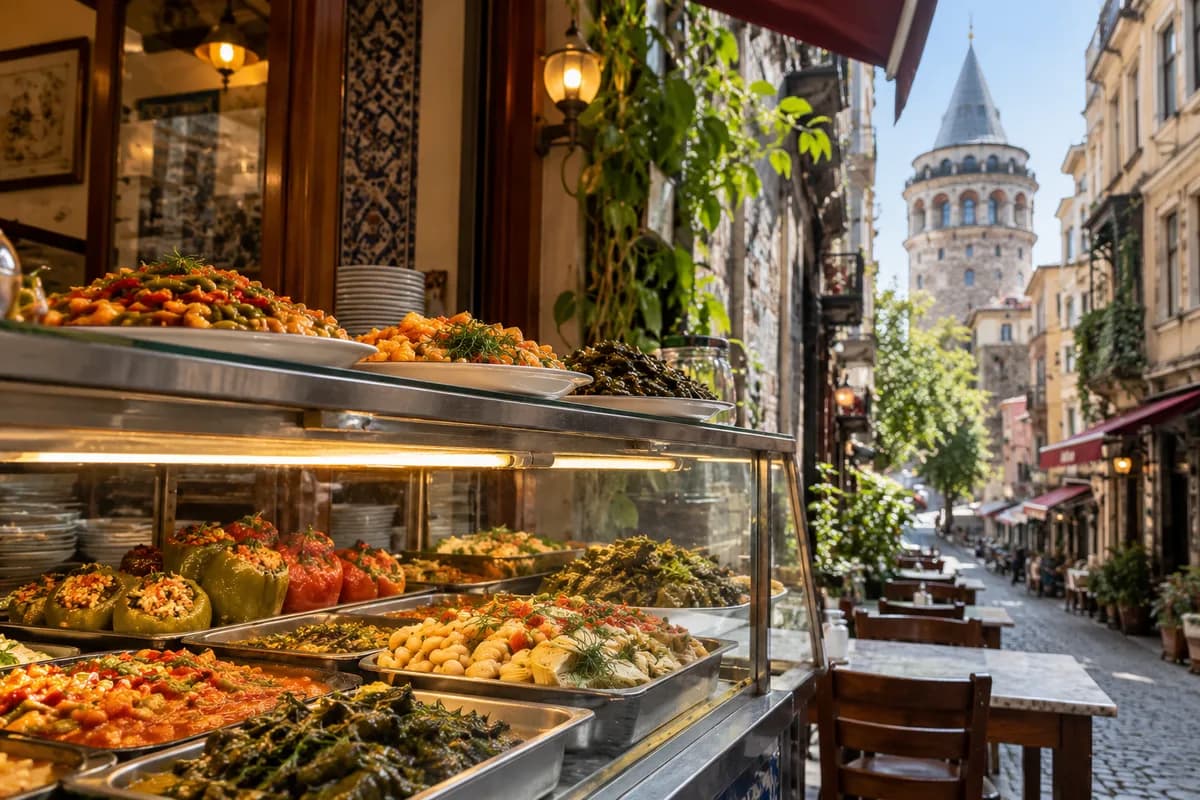
🍲 Start at the lokanta counter
A traditional lokanta can look confusing if you don't speak Turkish. Don't let that stop you. Walk up to the counter and look.
Depending on the day and season, you may find beans, chickpeas, stuffed vegetables, aubergine, okra, green beans and other vegetable dishes alongside rice, soups and meat dishes.
This is where you can encounter everyday Turkish cooking rather than food designed specifically for tourists.
But vegetable does not automatically mean vegan. Butter can find its way into rice and vegetables, while soups, beans and other dishes may be prepared with meat or chicken stock.
🗣️ Ask: “Bunda tereyağı, et suyu veya tavuk suyu var mı?”
Does this contain butter, meat stock or chicken stock?
👉 More ideas for eating inexpensively at neighborhood lokantas and elsewhere: Vegan Istanbul on a Budget.
🫒 Learn one useful word: zeytinyağlı
If you remember one food word during your Istanbul trip, make it zeytinyağlı.
Literally, it means “with olive oil,” but it also describes an entire tradition of vegetables and legumes cooked with olive oil and generally served cold or at room temperature.
Look beyond the familiar imam bayıldı. Depending on the kitchen and season, you might encounter barbunya pilaki (borlotti beans), zeytinyağlı enginar (artichoke), taze fasulye (green beans), kereviz (celeriac), bamya (okra), broad beans or stuffed vine leaves.
Many are plant-based by tradition rather than adaptation.
🌱 Still, zeytinyağlı is a very useful clue, not an absolute vegan guarantee. Ask before ordering, particularly about stock, yogurt or other additions.
👉 Not sure what the word means on a menu? Read What Does “Zeytinyağlı” Actually Mean?.
🥗 Don't walk past the meyhane
Seeing fish on display or meat on a menu can make a vegan traveler dismiss a traditional meyhane immediately.
That can mean missing one of Istanbul's most distinctive eating experiences.
The reason is meze. Instead of thinking about starters and mains, look at the cold meze counter and build a table from several small dishes. Fava, barbunya pilaki, acılı ezme, artichokes, sea beans and vegetable dishes are among the possibilities you may encounter.
A collection of meze can become dinner rather than simply the beginning of it.
There is an important catch. The meze counter also contains plenty of dairy, seafood and occasionally egg. Similar-looking aubergine dishes, for example, can have completely different ingredients.
🗣️ Ask about each dish separately rather than assuming the whole vegetable section is vegan.
👉 Explore the tradition and its plant-based possibilities in Istanbul & Anatolia: A Multicultural Vegan Meze Table
🍅 Don't reduce Turkish breakfast to cheese and eggs
At first glance, the classic Turkish breakfast table doesn't look particularly vegan. There are eggs, several cheeses, butter, honey and sometimes sucuk.
Look again.
Olives, tomatoes, cucumbers, herbs, walnuts, tahini and pekmez, fruit preserves, bread and tea can already occupy much of the table. Some places also offer vegetable spreads, olive-oil dishes and other plant-based additions.
Rather than ordering a fixed serpme kahvaltı and removing half of it, ordering individual dishes can sometimes make more sense.
⚠️ Check breads and pastries for milk, butter and eggs. Honey is also common at breakfast, so don't confuse it with pekmez, the grape or fruit molasses found on many tables.
👉 See our dedicated Vegan Turkish Breakfast: A Tourist's Guide before sitting down for breakfast.
🌰 Eat something from the street
Not every vegan meal needs a reservation, menu or restaurant.
Roasted chestnuts and plain grilled or boiled corn are among the simplest options you'll see while walking around Istanbul. Simit, the sesame-covered bread ring sold across the city, is another familiar possibility, although recipes can vary.
Then things get more complicated.
Çiğ köfte is commonly prepared without meat today, but sauces and wraps should still be checked. Kumpir starts with a baked potato but is normally mashed with butter and cheese. Nohutlu pilav may contain butter or chicken stock. Vegetable gözleme can contain cheese, while its dough or cooking process may involve dairy.
Street food rewards curiosity, but don't judge it by appearance alone.
👉 Keep our Vegan Street Food in Istanbul guide handy while exploring the city.
🍬 Don't end your search at baklava
Baklava is everywhere, which also makes it one of the first desserts visitors ask about.
Standard baklava should not be assumed vegan because butter is normally part of the recipe. Instead of spending the whole trip hunting for a vegan version of one famous dessert, look at what else Turkish sweet culture offers.
Depending on where you go, possibilities can include zerde, aşure, pumpkin dessert served without kaymak, and some varieties of lokum. Traditional confectioners, markets and sweet shops also open up choices that you won't necessarily find on restaurant dessert menus.
Again, recipes matter. Milk, butter, honey, eggs and kaymak can change the answer.
🍬 Even lokum isn't universally vegan: plain versions may be suitable while cream-filled, kaymaklı and some chocolate varieties are not.
👉 Take a look at Vegan & Vegetarian Turkish Desserts to Try in Istanbul before heading into a traditional sweet shop.
🗣️ The question that unlocks more of Istanbul
There is a common thread running through all of these places.
Don't search only for a vegan label. Ask how the food was made.
A dish can have no visible meat and still contain butter, yogurt or meat stock. Etsiz means meat-free, not necessarily vegan. And a vegetable dish isn't automatically plant-based simply because vegetables are the main ingredient.
When you need to be clear, try:
“Veganım. Et, tavuk, balık, et suyu, tavuk suyu, süt, yoğurt, peynir, tereyağı, yumurta ve bal yemiyorum.”
“I'm vegan. I don't eat meat, chicken, fish, meat or chicken stock, milk, yogurt, cheese, butter, eggs or honey.”
👉 First visit? Save our First-Time Vegan in Istanbul: What You Need to Know.
🌿 Look beyond the label
Istanbul has fully vegan restaurants and cafés, and they can make traveling much easier. But they are only one part of the city's plant-based story.
Walk into a lokanta. Examine the zeytinyağlı counter. Ask what is vegan at a meyhane. Build your own breakfast. Buy chestnuts on the street. Step inside an old-fashioned confectioner.
Some of the food you remember most from Istanbul may come from a place that never described itself as vegan at all.
Just remember the other half of the rule: traditional doesn't automatically mean vegan either. Ask first, then eat. 🌱