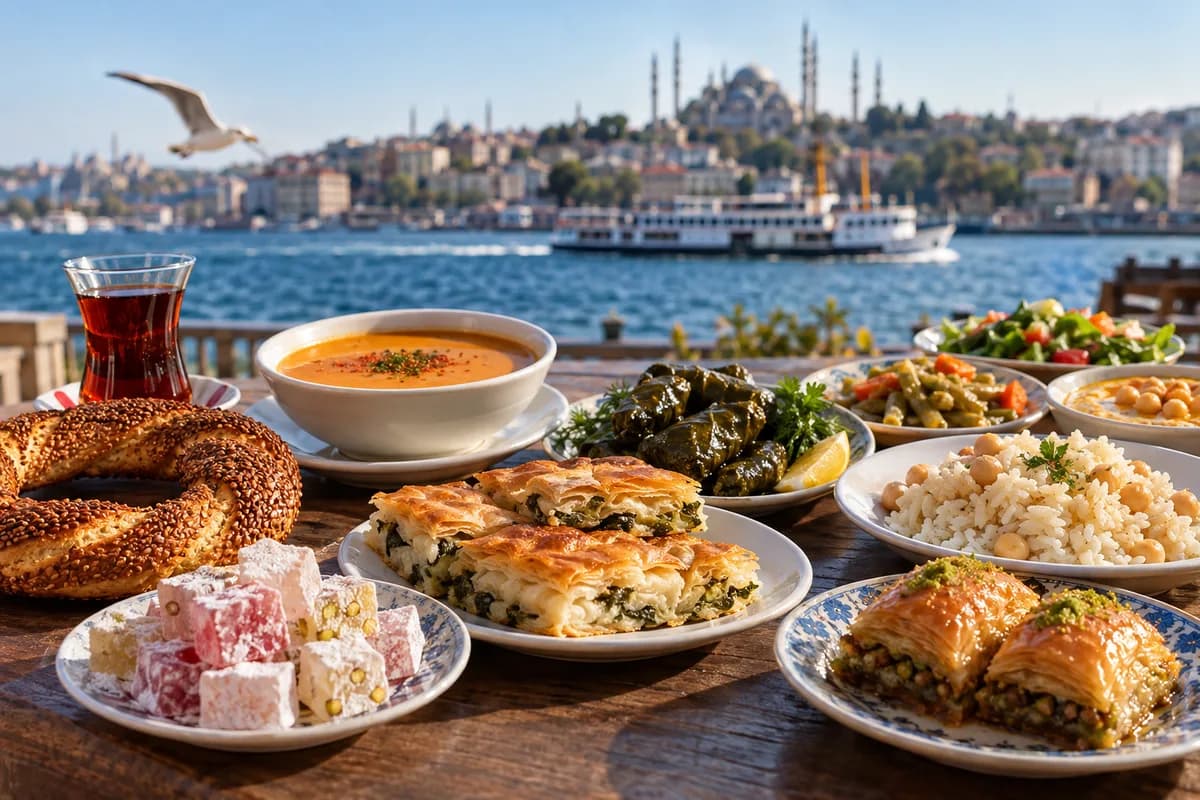
The Biggest Vegan Myths in Istanbul: 12 Things That Aren’t Always Vegan 🌱
Some of Istanbul’s most familiar foods look vegan at first glance, while others are more vegan-friendly than visitors assume. 🌱 From lentil soup and pilav to simit, meze, lokum and baklava, the name or appearance doesn’t always tell the whole story. These are 12 common vegan myths worth knowing before you order.
You see a tray of beans in olive oil. A bowl of red lentil soup. Rice with chickpeas. A sesame-covered simit from a street cart. Nothing looks remotely like meat.
That still doesn't answer the vegan question.
Some of the most persistent vegan myths in Istanbul come from foods that really can be vegan. The mistake is turning “often vegan” into “always vegan.”
Here are 12 assumptions worth dropping before you order. 👇
🥣 MYTH 1: “Lentil soup is vegan”
Reality: It can be, but the name mercimek çorbası tells you the main ingredient, not the complete recipe.
Different kitchens prepare lentil soup differently. Butter and meat-based stock are among the ingredients that need checking. A perfectly plant-based-looking bowl therefore isn't enough evidence.
👉 Ask: “Tereyağı, et suyu veya tavuk suyu var mı?”
Does it contain butter, meat stock or chicken stock?
For more phrases you can actually use at the table, see our How to Order Vegan Food in Turkish guide.
🍚 MYTH 2: “Rice is just rice”
Reality: Not necessarily in a restaurant kitchen.
Turkish pilav may be prepared with butter or stock. That matters for plain rice as well as the very tempting nohutlu pilav, rice with chickpeas.
The chickpeas don't make the cooking liquid vegan.
👉 Ask how the rice was cooked rather than whether there is meat on the plate.
Our Vegan Street Food in Istanbul guide has more on nohutlu pilav and other foods you will encounter around the city.
🫒 MYTH 3: “If it says zeytinyağlı, I don't need to ask anything”
Reality: Zeytinyağlı is one of the most useful words a vegan visitor can learn in Istanbul. But it is a culinary category, not a certification logo.
Classic zeytinyağlı vegetable dishes provide some of the easiest plant-based choices in Turkish cooking. The important distinction is between versions: zeytinyağlı yaprak sarma, for example, is not the same dish as meat-filled etli sarma.
And what arrives beside the dish matters too. Yogurt is a common accompaniment to various vegetable dishes.
Explore the wider range in What Can Vegans Eat in Turkey? A Guide to Traditional Turkish Food.
🥗 MYTH 4: “Sebzeli means vegan”
Reality: It means “with vegetables.”
That is all.
A sebzeli pastry can contain cheese. A vegetable dish can be cooked with butter. A vegetable soup can contain dairy or stock. The adjective describes what is in the dish, but doesn't necessarily tell you everything else that went into it.
This is one reason reading a Turkish menu literally can be misleading for visitors.
If this is your first trip, start with First-Time Vegan in Istanbul: What You Need to Know.
🥟 MYTH 5: “Potato or spinach börek must be vegan”
Reality: A vegetable filling doesn't tell you what is in the pastry.
Börek can involve butter, milk, yogurt, egg or cheese depending on the type and recipe. Even when the filling itself is suitable, the dough, layers or glaze may not be.
The same principle applies to many bakery products: don't judge the whole pastry by the filling you can see.
Our Is It Really Vegan? Hidden Ingredients in Turkish Food explains what else to check at bakeries, lokantas and meze counters.
🥯 MYTH 6: “Simit isn't vegan”
Reality: This myth works in the opposite direction.
Classic simit is generally made from plant-based ingredients such as flour, water, yeast, salt, grape molasses and sesame. So vegans don't need to automatically avoid Istanbul's most visible street snack.
But recipes aren't identical everywhere. Café and bakery variations can differ, particularly filled or flavoured versions.
In other words, simit is generally a good candidate, not something to fear and not something to treat as universally guaranteed.
We looked at it separately in Is Simit Vegan?.
🌯 MYTH 7: “Çiğ köfte contains raw meat”
Reality: The name confuses many visitors because çiğ köfte historically refers to a dish associated with raw meat. The commercial meat-free version widely sold today is a different proposition and is often suitable for vegans.
But don't stop checking at the köfte itself.
Sauces and accompaniments can change the answer. If you are buying a dürüm, ask about everything going into the wrap, particularly creamy sauces.
This is one of the inexpensive options covered in our Vegan Istanbul on a Budget guide.
🥮 MYTH 8: “Baklava is nuts, pastry and sugar syrup, so it must be vegan”
Reality: The nuts and syrup aren't usually the main problem.
Traditional Turkish baklava normally uses butter or clarified butter between its layers. Recipes can also differ in the pastry itself.
Another misconception is that baklava is non-vegan simply because its syrup must contain honey. Turkish baklava is commonly made with sugar syrup, so asking only about honey can make you miss the butter.
We separated fact from assumption in our full Is Baklava Vegan? guide.
🍬 MYTH 9: “Turkish delight contains gelatin”
Reality: Traditional lokum is generally based on sugar and starch rather than gelatin.
This is another case where imported assumptions can make vegans unnecessarily avoid a traditional food.
But there is an important second half to the answer: not every product sold as lokum has the same ingredients. Chocolate-covered, creamy, milk-flavoured and other modern varieties need their own ingredient check.
So don't ask whether “Turkish delight” as an entire category is vegan. Ask about the particular lokum in front of you.
Our article can help you understand Is Turkish delight vegan?
🍳 MYTH 10: “A Turkish breakfast can be made vegan by removing the eggs and cheese”
Reality: That removes the obvious animal products, not necessarily all of them.
A traditional breakfast table can also include butter, honey, kaymak and pastries. At the same time, there may be plenty left for a vegan: olives, tomatoes, cucumber, herbs, fruit preserves, tahini and pekmez, suitable breads and other plant-based dishes.
So the useful approach isn't to reject the entire breakfast or simply remove two plates. Build the breakfast around the plant-based components and check the breads, pastries and cooked dishes separately.
See our Vegan Turkish Breakfast: A Tourist’s Guide before ordering a large serpme kahvaltı.
🧆 MYTH 11: “Meze means vegan”
Reality: Meze tells you how a collection of small dishes fits into a meal, not whether those dishes contain animal products.
Many familiar mezes are built around vegetables, legumes, herbs and olive oil. Others contain yogurt, cheese, mayonnaise or seafood.
This is actually good news for vegan travellers: you don't need to avoid the meze counter. You need to choose dish by dish rather than treating “meze” as an ingredient category.
The same principle opens up far more of Turkish cooking than searching only for dishes carrying a vegan label. Our Vegan Turkish Food in Istanbul: What Can You Eat? has more examples.
🍽️ MYTH 12: “A restaurant with a vegan option is a vegan-friendly restaurant”
Reality: One hummus, salad or plate of fries doesn't tell you much about what kind of meal a vegan can actually have.
There is a useful difference between “this restaurant has something I can eat” and “this restaurant offers enough vegan food for a proper meal.”
That distinction matters when you're choosing where to spend lunch or dinner rather than looking for an emergency snack.
On veganistanbul.com, we take a conservative approach to that difference. A venue doesn't become meaningfully vegan-friendly simply because one or two incidental plant-based sides happen to be available.
🌿 So what should you trust?
Not appearances. Not the word sebzeli. Not etsiz on its own. And not the assumption that every kitchen in Istanbul prepares a traditional dish in exactly the same way.
But don't go to the opposite extreme either.
Istanbul has a large repertoire of vegetable, legume, grain and olive-oil dishes that can make eating vegan much easier than a first glance at a kebab-heavy tourist menu might suggest. The point isn't to become suspicious of every plate. It is to know which question matters for which food.
At a lokanta, ask about the cooking fat and stock.
At a bakery, ask about the dough, glaze and filling.
At breakfast, check the spreads, pastries and cooked dishes.
At a sweet shop, ask about the particular product rather than the entire category.
And when language gets in the way, save our Vegan & Vegetarian Istanbul FAQ on your phone.
The safest Istanbul food rule may also be the simplest:
A dish name is a clue. The recipe is the answer. 🌱